
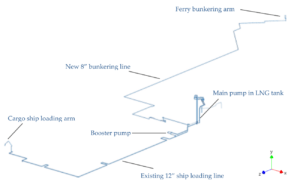
Surge analysis of a new LNG bunkering line connected to an existing ship-loading system
Extending an LNG terminal with a new cryogenic bunkering line At an LNG storage and loading terminal, a new line was constructed to supply liquefied natural gas directly to ferries. This 8-inch bunkering line branches from an existing 12-inch line that is used to load LNG into cargo ships. A
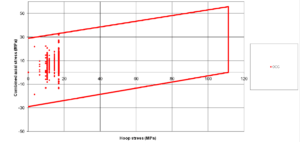
Dynamic Analysis of Composite Firewater Deluge Piping Under Valve-Closure Surge
Surge loads from deluge valve closure were applied to nine composite firewater deluge systems in a CAESAR II time-history analysis and checked as occasional stresses against the ISO 14692 envelope. With three axial stops added in S4, all stress points lie within the envelope; the highest of the nine Smax
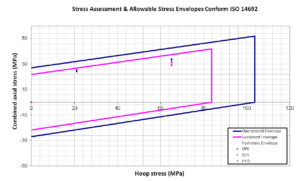
Stress Verification of a Buried GRE Pipeline With Replacement Bends
Elbows replaced after hydrotest problems A 5-inch glass-reinforced epoxy (GRE) transportation line runs buried between two locations. It connects to above-ground steel piping at both ends and to a steel manifold at about halfway. In total there are four connections between GRE and steel. The line is designed for 150
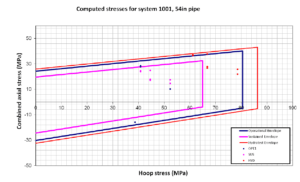
Static Stress Analysis of a Buried GRP Seawater Network
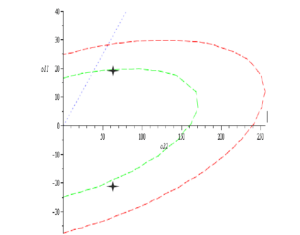
Buried Fibreglass Piping and an Undefined Compression Envelope The underground part of a seawater network at a gas field development was to be built in filament-wound fibreglass reinforced epoxy pipe buried in sand. The scope covered two systems, 1001 and 1002. Each system consists of a header of 54-inch and
Finite Element Stress Analysis of GRP Couplers (FWC)
This project covered a family of glass fibre reinforced plastic (GRP) couplers, designated FWC, in five configurations: a DN600 coupler in a small (S) and a medium (M) variant, a DN1200 medium coupler, a DN2400 large coupler, and a DN3600 extra large coupler. Each coupler is a long cylindrical GRP

GRP Pipe Supplier Design Review Against a Performance-Based Code
Technical Evaluation of Three Candidate GRP Pipe Suppliers For a glass-reinforced plastic (GRP) pipe system on a project, the client selected three potential GRP pipe suppliers, each to be evaluated from a technical perspective. Each supplier submitted a set of technical documents describing its component design, qualification testing and system
Strength Assessment of a 42-Inch GRE Seawater Dump Caisson
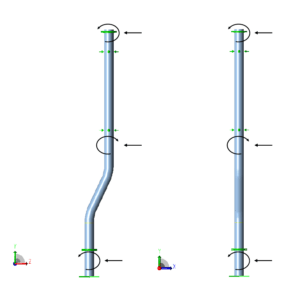
A seawater dump caisson made of glass-reinforced epoxy (GRE) needed its wall, laminate and joint details defined. The task was to find thicknesses and bonding lengths that would keep stresses within the allowable stress envelope conforming to ISO 14692, and to determine the loads that the restraints, flanges, laminated joints
A Buried GRE Firewater Network Brought Within ISO 14692
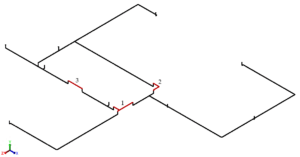
The Firewater Network The firewater network in this case is built from glass-fibre reinforced epoxy (GRE), grade Wavistrong EST 20, with DN150 pipe running mainly underground. Above ground, steel sections connect to the GRE by flanges, and vertical branches rise to fire hydrants and similar connections. The system was specified

Verifying Manhole-Equipped Pipe Fittings Using Finite Element Analysis
A manhole interrupts the load-bearing shell of an elbow or tee, so the component is regarded as a non-standard piping fitting. The three fittings here are two 20 inch long-radius elbows, EX-23 and EZ-22, in SA-234 Gr. WP11 Cl. 1, and one 32 inch ASME B16.9 welding tee, FB-11, in

Static Stress Analysis of a Furnace Coil Outlet Piping
Furnace F-501 at a refinery heats crude through radiant coils made of A312 TP316Ti stainless steel. Each coil enters the radiant section at grade level, runs 21 loops parallel to the refractory lined furnace wall, crosses over to the roof section, makes 8 further loops against the roof, and leaves

CFD Analysis of Pump Suction Line Flow Uniformity for Refinery Service
Two identical Visbreaker bottom pumps at an onshore refinery were due for replacement. The existing pumps were of single side suction execution, the new pumps of double side suction execution. For the new pumps a minimum straight length of five times the diameter (5D) was specified directly upstream of the

Dynamic Stress Modelling of a Two-Phase Gas Line Between Hydrocracker Separators
A gas line between the high and low pressure separators of a hydrocracking unit failed in service, probably through material fatigue caused by vibration. An additional 3-way stop was fitted just downstream of the TSO valve to reduce vibration levels, and vibration was then measured at nine locations on the

Vibration Analysis and Flange Leakage Analysis of Crude Furnace Piping
The crude heating system serves one of two distillation trains: crude is preheated in a convection box, heated in the radiant section of the furnace and carried by a feed line to the tower. Crude heating generates two-phase flow, whose fluctuations impose the unsteady unbalanced loads at elbows and tees

Static and Modal Analysis of a Failed Desuperheater Branch Connection
At a refinery, a branch connection designated W31056, the 2″ line that ties in to the high-pressure steam attemperator J-3103 (a desuperheater), failed in service. A similar failure had occurred about twenty years earlier, in 1992. On-site observations report periodic movement of the connecting header, line 6″-S31022, which contains the

Replacing a Steel Cooling Water Header with Glass Reinforced Epoxy
A refinery operator is replacing two existing steel main cooling water headers with Glass Reinforced Epoxy (GRE) piping. The two changes were raised as Technical Change Requests, and this case study covers the second of them, the “lube” cooling water header. The GRE consists of a header and a branch

Slug flow vibration in the two-phase section downstream of an angle control valve
A wash oil line was vibrating in the vertical section downstream of its angle control valve. It has been reported that the vibration amplitude increases with increasing flow, and in the future the mass flow rate may still be increased further. No vibration measurements had been carried out, so the

Vibration Measurement and Fatigue Assessment of a Refinery Wash Oil Line Subject to Slug Flow
Undesirable vibrations were observed in the wash oil line between two vessels during activation of the wash oil flow, most severe in the vertical section immediately downstream of the angle control valve. An earlier study had already identified slug flow as the most probable cause and proposed mitigation measures, and

Slug-Flow Vibration and Expansion Stress in the 10-Inch Two-Phase Lines of a Refinery Furnace
The 10″ inlet and outlet lines of furnace H301 carry two-phase content during all process conditions. Under certain process conditions, staff reported feeling like getting seasick when standing on the platform of the furnace, and the piping was seen vibrating mainly near the furnace. The impact of these dynamic effects

Stress Analysis of a Flue-Gas Overhead Line Operating in the 304H Creep Range
A flue-gas overhead line runs from a third stage separator to a waste heat boiler. It carries gas at a maximum operating temperature of 740 °C upstream of the orifice chamber and is designed for 755 °C in the hot-walled sections. At those temperatures the hot-wall material, stainless steel A240

Flexibility Analysis of a GRE Cooling Water Header Replacement
Two existing steel cooling water headers were to be replaced with Glass Reinforced Epoxy (GRE) piping under two Technical Change Requests. This case study covers the first request, for the main cooling water header “boiler”. The second, covers the “lube” header. A flexibility analysis was required, together with recommendations, to

Slug-Flow Vibration Assessment of an 8-Inch Two-Phase Refinery Line
An 8-inch line carrying two-phase content from a heat exchanger to a gasoil stripper at a refinery had been vibrating for years, mainly in the two shorter horizontal sections, one downstream of the heat exchanger and one just upstream of the stripper. The operator had reported vibration for 5 to