

Stress and surge analysis on the GRE seawater cooling piping for an ammonia plant
The client is operating multiple ammonia plants with similar cooling water systems made of GRE. Last year, failures were discovered in buried GRE components—specifically, an elbow and a tee—at one of the older plants. A surge analysis conducted by Dynaflow Research Group revealed that these failures were due to an

Surge analysis for firewater system for Green Hydrogen Facility
A new firewater (FW) system is being designed for a Green Hydrogen Elements facility. The plant spans a large area of approx. 2 x 1.5 km and contains multiple critical areas. The piping material is Fiber Reinforced Plastic (FRP). The main firewater ring is of DN250 and DN300 piping. The

Surge and Stress Analysis for a Firewater System
A client designed a foam piping system that covers the three tanks in a tank pit in the harbor. The firewater system is directly connected to the general water supply. The main pipeline passes through the foam house where the water is mixed with foam. A manifold divides the mixture

Pulsation damper sizing according to API 619
A manufacturer of pulsation dampers requested Dynaflow Research Group to verify the performance of one of its discharge silencer designs in combination with a double rotary lobe gas blower by means of a pulsation study. The scope of the study consisted of a connecting straight pipe spool and the silencer

Fatigue Analysis For A Reactor Feed Pressurization Drum
A fatigue analysis has been done for a reactor feed pressurization drum. The vessel operates under cyclic pressure ranging from 25 psig to 200 psig (1.7 – 13.8 bar), with a design life of more than 5 million cycles. Additionally, it is subjected to 200 full-range cycles from atmospheric pressure

GRE Fire Water Header on a Jetty: Static Stress and Seismic Load Analysis
A Glass Reinforced Epoxy (GRE) fire water header, installed on a Liquefied Natural Gas (LNG) jetty, comprises DN700 pipes and is subjected to seismic accelerations. Due to the jetty’s structure, the seismic accelerations provided by the client vary significantly along its length. The fire water header must be evaluated for

Seawater Supply Header: Static Stress Analysis
The above-ground seawater supply header is designed to transport seawater from two tie-ins in a discharge manifold of the seawater pumps to AGA. A comprehensive static stress analysis was necessary to determine the stress levels within the Glass Reinforced Epoxy (GRE) line. Additionally, it was crucial to define a support

Incident Analysis for Plastically Deformed Line Due to Settlement
At an LNG terminal, an unexpected settlement of 12 inches of soil, containing several sections of Vacuum Insulated Piping (VIP), occurred. Because the above-ground pipe supports were unaffected by the settlement, the differential displacement between the above-ground supports and the underground soil resulted in plastic deformation of some of the
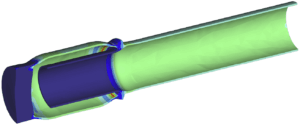
Verification of a Continuous Steam Generation System (SGS): Static Stress Assessment
This case study explores the static stress assessment of a continuous steam generation system (SGS) using finite element method analysis. The focus is on a small-diameter plant that utilizes molten salt to generate steam in a heat exchanger at a solar plant facility. The plant includes four sequential components: an

Gasholder Sizing Review: An Analytical Case Study
This case study presents a comprehensive review of gasholder sizing within a cokes gas network. The primary objective is to evaluate the impact of adjusting the gasholder size on reducing annual flaring volumes and providing a buffer for short-term discrepancies between cokes gas production and consumption. The study explores various

Sulphur Recovery Burners Assessment: Stress Analysis
DRG was engaged to conduct a stress analysis for two sulphur recovery burners, adhering to ASME VIII Division 1 Boiler and Pressure Vessel Code. This analysis involved traditional Division 1 calculations complemented by Finite Element Analysis (FEA) to evaluate the impact of nozzle loads on critical junctions. Additionally, an assessment

Finite Element Analysis of Filament Wound Pipe Coupler
This case study focuses on the finite element analysis (FEA) conducted for a filament wound coupler designed for 42-inch centrifugal cast fiberglass pipes. The objective was to evaluate the performance of the fiberglass coupler under various conditions to ensure it meets the required specifications. Analysis The filament wound couplers (FWC)

Design Verification of a Thermal Energy Storage System (TESS): Static and Fatigue Assessment
A comprehensive finite element method (FEM) analysis was conducted on a molten salt/oil heat exchanger used in a solar plant facility. This heat exchanger is one of three identical units connected in series, operating under high pressures and temperatures with significant pressure and temperature cycling throughout day and night. To

Assessment of a Vacuum Tower with Additional Scaffolding Loads
In maintenance operations involving a vacuum tower approximately 50 meters in height, additional scaffolding is necessary. This scaffolding introduces increased wind loads, which, in turn, can elevate compressive stresses at the base of the tower. Such elevated stresses may lead to potential buckling or localized high stresses within the tower,
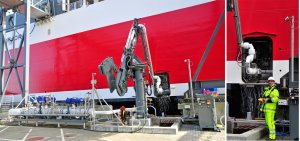
Stress Analysis of LNG Bunkering Line: Dynamic and Static Evaluations
At a Liquefied Natural Gas (LNG) plant, a new LNG bunkering line is being constructed to supply ships with liquid LNG. This project involves the installation of new piping, which will be completed in multiple phases. This case study focuses on evaluating the material stresses, as well as the loads

Fatigue Analysis of Interconnecting Lines between Norit Vessels and Heat Exchangers
Since the early 1980s, cracks have been observed in the off-gas cleaning section of the ethylbenzene hydroperoxide (EBHP) reaction unit. To address environmental concerns, EBHP must be removed from the off-gas before flaring. This process involves absorbing EBHP in norit beds within norit vessels, followed by cleaning the vessels with

Stress Assessment of Skirt-to-Head Weld Region Using Finite Element Analysis
Finite Element Analysis (FEA) is conducted on the skirt-to-head weld of an Acetylene Converter to evaluate the impact of a hot-box installation. Positioned on the interior side of the skirt in the skirt-to-head weld area, the hot-box aims to mitigate thermal bending stresses within the joint. The thermal analysis is

Main Burner Stress Analysis Case Study
This case study examines a stress analysis conducted in accordance with ASME VIII Division 1 Boiler and Pressure Vessel Code for a main burner system. The burner in question features a vessel with an air inlet nozzle and connects to a “gun” with both a fuel gas inlet and an

Analysis of Wastewater Treatment Reactors with Parasitic Chemical Reactions: A Flow Analysis Study
This case study explores the findings from a detailed flow analysis conducted on three different wastewater treatment reactors. In these reactors, component ‘A’ is intended to be removed from the wastewater stream by converting it into component ‘B’. However, the original reactor design exhibited a significant parasitic reaction, where ‘A’

Influence of Filter and Geometry on Flow Patterns in Pump Suction Lines: A CFD Flow Analysis
This case study examines the findings from a comprehensive flow analysis conducted on two identical suction lines connected to VIS Breaker Bottom Pumps. The existing Bottom Pumps were slated for replacement with new models. According to the pump supplier’s specifications, a minimum straight length of five times the diameter (5D)

Double Burner-Chamber Assembly Stress Analysis
A comprehensive stress analysis was conducted on an assembly comprising two burners and two interconnected chambers. Each burner generates a substantial flame, which combusts waste gas within the chambers. The top chamber is stacked atop the bottom chamber, with both chambers connected by piping that channels flue gas to the