
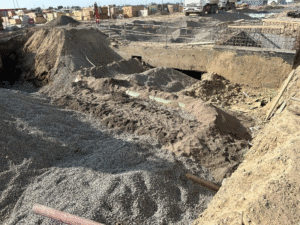
Assessment of GRP Piping Installation at a Power Plant
This case study presents a technical assessment of the Glass Reinforced Plastic (GRP) piping system installation at a power plant, based on a visit conducted at its site. The evaluation focused on the material quality, engineering, and site installation activities for the project’s cooling water and firewater systems. Particular attention

Material Testing and Root Cause Analysis of Multiple Failures in Underground FRP Firewater Network
The client experienced multiple unexpected failures in the underground firewater (FW) network at one of their facilities. The network utilizes fiberglass-reinforced plastic (FRP) piping. To determine the root causes of these failures, a material investigation was conducted by Dynaflow Research Group on pipe samples. This case study presents the methodology,
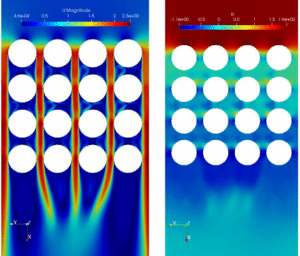
Flow-Induced Vibration Analysis in Heat Exchangers at Shagaya CSP Plant
A heat exchanger was found to have fluid leakage from the tube side into the shell side after approximately 3 years of operation. Initial inspections suggested that flow-induced vibrations (FIV) were causing support rods to puncture through tube walls. To diagnose and address the source and effects of the FIV
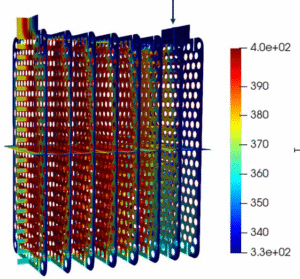
CFD Analysis and Optimization of Tube Cooker Designs
This project presents a detailed technical assessment of two vertical tube cooker (shell-and-tube heat exchanger) designs using Computational Fluid Dynamics (CFD). The analysis was conducted for Tanis, a manufacturer of candy production lines, with the objective of verifying and improving the thermal performance of the tube cooker, a critical process
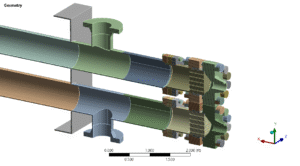
Finite Element Analysis of a Hairpin Heat Exchanger
Dynaflow Research Group was asked to conduct a comprehensive finite element (FE) analysis on a custom hairpin heat exchanger. The primary objective was to assess the exchanger’s structural integrity under demanding cyclic loading conditions, focusing on fatigue life and ratcheting behavior in compliance with the ASME Boiler and Pressure Vessel

CFD Two-Phase Mixing Flow Analysis of a 60 m³ H₂S Bioreactor
Effective mixing in bioreactors is essential for maximizing mass transfer, homogenizing chemical species, and ensuring uniform biological activity. The client undertook a computational fluid dynamics study in collaboration with Dynaflow Research Group to evaluate the performance of a 60 m³ hydrogen sulfide (H₂S) bioreactor, with a specific focus on mixing
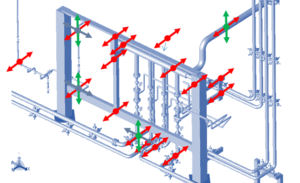
Vibration Analysis and Mitigation for Compressor C801 Discharge Piping
Excessive vibrations were detected in the discharge piping of compressor C801 at BP Rotterdam. The observed vibration frequencies corresponded to the compressor’s running speed and its harmonics, indicating the compressor as the primary excitation source. This prompted an in-depth technical investigation due to concerns over the integrity and reliability of
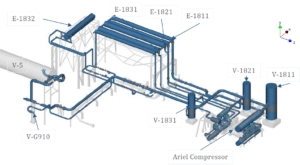
API 618 Design Approach 3 (DA3) Pulsation and Vibration Analysis at Q8 Terminal
The API 618 DA3 study at the Q8 Terminal, commissioned by Wintershall Noordzee and executed by Dynaflow Research Group, was initiated to ensure the mechanical reliability and performance of the reciprocating compressor piping system. This study focuses on the evaluation of pulsation and vibration per API 618 (5th Edition, 2007)

Stress Assessment of the Q8 Terminal Compressor Station
Building directly on the preceding site verification and model augmentation phase, the objective of the stress assessment was to ensure the mechanical integrity and regulatory compliance of the entire piping network under all anticipated operational, test, and environmental scenarios. The assessment was carried out in accordance with ASME B31.3 and

Site Visit Results and Model Augmentation for the Compressor Station
Following the initial review of the pulsation and vibration analysis for the Q8 Terminal compressor station, a detailed site visit was conducted to resolve ambiguities in the as-built system configuration. The purpose of this site visit was to verify support functionality, assess current installations, confirm actual piping layouts, and gather
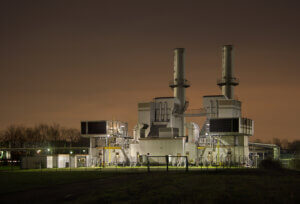
Third-Party Pulsation Analysis Review for Terminal Compressor Station
This case study presents a critical review of the pulsation and vibration analysis carried out by a third-party supplier, focusing on the Q8 Terminal compressor station. The analysis, conducted in accordance with API 618 Design Approach 3, aimed to assess the dynamic response of the compressor and associated piping systems.

Dynamic stress response of the Ærfugl MEG Injection Skid
The Ærfugl MEG (Monoethylene Glycol) injection skid, engineered by Hitec Products AS for deployment on the Skarv FPSO, is a critical system designed to inject MEG into subsea flowlines, thereby preventing hydrate formation. Following the comprehensive pulsation analysis, which established compliance with API 674 DA2 pulsation criteria through targeted mitigation

Pulsation Analysis of the Ærfugl MEG Injection Skid
Following the successful verification of the static mechanical integrity of the Ærfugl MEG injection skid in Phase 1, Hitec Products AS commissioned Dynaflow Research Group to undertake a detailed pulsation analysis in accordance with API 674 DA2. The aim was to address the risks posed by pressure pulsations generated by

Static Pipe Stress Analysis for Ærfugl MEG Injection Skid
The Ærfugl MEG (Monoethylene Glycol) injection skid, designed and produced by Hitec Products AS for installation on the FPSO (Floating Production Storage and Offloading) vessel in the Skarv field, is a mission-critical component in the field’s flow assurance strategy. To ensure mechanical integrity and operational reliability, a comprehensive static pipe

Application of CFD to Assess and Optimize Liquid Mixing in Large Storage Vessels
Within Europoort Rotterdam, a tankpit of 37m diameter and 21m height was intended to be repurposed for storing a blend of Naphtha and Reformate. Reformate, a product of Naphtha, shares similar chemical properties, with both fluids being miscible (they mix well together). Dynaflow Research Group performed a CFD analysis on
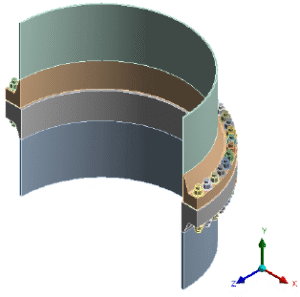
Analysis of Large Dissimilar Bolted Flanges
For a coil-wound liquified natural gas (LNG) heat exchanger, an existing 66” and new 72” bolted flange joint have been analysed and reviewed for mechanical loading and multiple thermal load cases in accordance to the 2013 edition of ASME VIII Div.1 and Div.2 by Dynaflow Research Group (DRG) using ANSYS

Managing Surge and Stress in Firewater System Extensions for LNG Terminals
Dynaflow Research Group (DRG) has performed a stress and surge analysis using BOSfluids at Rotterdam Maasvlakte on an extension to their firewater system to accommodate the loading of LNG onto ships and barges at the jetty area. The extension of the firewater system consisted of an underground glass-reinforced epoxy (GRE)

Pipe Stress Analysis for a Firewater GRE system
An existing fiberglass firewater piping system was expanded to enhance its capacity, necessitating validation for the newly added components. The client, engaged in the RDCG Rotterdam capacity growth project, specializes in producing renewable fuels through the chemical conversion of vegetable and animal oils. The firewater system at this facility is

Mixing Flow, Surge and Pipe Stress Analysis
Our client was looking to repurpose a liquid transport and storage system for a different fuel. The new fuel blend has a larger viscosity and density. Heat tracing is applied to the pipe line to reduce the liquid viscosity during transport. The new fuel is pumped into a storage tank,

Multiphase CFD Study of Separation Tank
Our client reported multiple cracks at weld locations on a separation tank. These cracks are suspected to be caused by dynamic flow effects from the mixed inflow of acid gas and liquid. To address this issue, the client requested a Computational Fluid Dynamics (CFD) analysis to quantify the forces exerted

Multiphase Flow & Vibration Analysis of PSV Discharge
A client approached Dynaflow with concerns about potential dynamic loads on their piping system during the activation of a Pressure Safety Valve (PSV) protecting a degasser. During PSV opening, both gas and liquid (methane and water) are discharged together, creating complex flow conditions that could lead to transient forces and