

Dynamic Stress Modelling of a Two-Phase Gas Line Between Hydrocracker Separators
A gas line between the high and low pressure separators of a hydrocracking unit failed in service, probably through material fatigue caused by vibration. An additional 3-way stop was fitted just downstream of the TSO valve to reduce vibration levels, and vibration was then measured at nine locations on the

Vibration Analysis and Flange Leakage Analysis of Crude Furnace Piping
The crude heating system serves one of two distillation trains: crude is preheated in a convection box, heated in the radiant section of the furnace and carried by a feed line to the tower. Crude heating generates two-phase flow, whose fluctuations impose the unsteady unbalanced loads at elbows and tees

Static and Modal Analysis of a Failed Desuperheater Branch Connection
At a refinery, a branch connection designated W31056, the 2″ line that ties in to the high-pressure steam attemperator J-3103 (a desuperheater), failed in service. A similar failure had occurred about twenty years earlier, in 1992. On-site observations report periodic movement of the connecting header, line 6″-S31022, which contains the

Replacing a Steel Cooling Water Header with Glass Reinforced Epoxy
A refinery operator is replacing two existing steel main cooling water headers with Glass Reinforced Epoxy (GRE) piping. The two changes were raised as Technical Change Requests, and this case study covers the second of them, the “lube” cooling water header. The GRE consists of a header and a branch

Slug flow vibration in the two-phase section downstream of an angle control valve
A wash oil line was vibrating in the vertical section downstream of its angle control valve. It has been reported that the vibration amplitude increases with increasing flow, and in the future the mass flow rate may still be increased further. No vibration measurements had been carried out, so the

Vibration Measurement and Fatigue Assessment of a Refinery Wash Oil Line Subject to Slug Flow
Undesirable vibrations were observed in the wash oil line between two vessels during activation of the wash oil flow, most severe in the vertical section immediately downstream of the angle control valve. An earlier study had already identified slug flow as the most probable cause and proposed mitigation measures, and

Slug-Flow Vibration and Expansion Stress in the 10-Inch Two-Phase Lines of a Refinery Furnace
The 10″ inlet and outlet lines of furnace H301 carry two-phase content during all process conditions. Under certain process conditions, staff reported feeling like getting seasick when standing on the platform of the furnace, and the piping was seen vibrating mainly near the furnace. The impact of these dynamic effects

Stress Analysis of a Flue-Gas Overhead Line Operating in the 304H Creep Range
A flue-gas overhead line runs from a third stage separator to a waste heat boiler. It carries gas at a maximum operating temperature of 740 °C upstream of the orifice chamber and is designed for 755 °C in the hot-walled sections. At those temperatures the hot-wall material, stainless steel A240

Flexibility Analysis of a GRE Cooling Water Header Replacement
Two existing steel cooling water headers were to be replaced with Glass Reinforced Epoxy (GRE) piping under two Technical Change Requests. This case study covers the first request, for the main cooling water header “boiler”. The second, covers the “lube” header. A flexibility analysis was required, together with recommendations, to

Slug-Flow Vibration Assessment of an 8-Inch Two-Phase Refinery Line
An 8-inch line carrying two-phase content from a heat exchanger to a gasoil stripper at a refinery had been vibrating for years, mainly in the two shorter horizontal sections, one downstream of the heat exchanger and one just upstream of the stripper. The operator had reported vibration for 5 to

High Temperature Stress Analysis of an FCC Fluegas Overhead Line
A line in the creep range, where the weight loads set the support design The line studied here is the revised fluegas overhead line between the third stage separator and the superheater. It operates at 725 °C in the hot walled sections and 200 °C in the cold walled section,

Flexibility Analysis of a Stainless Steel Radiant Coil Replacement at 650 °C
A coil anchored at both ends, with the cross-over overloaded In a refinery furnace, the radiant coil carries crude. Under a project designated high TAN, the existing carbon steel radiant coil piping is to be replaced by stainless steel, grade A312 TP316Ti. This account presents the stress analysis of the

Reducing Slug-Induced Vibration on Four Two-Phase Hydrofiner Lines
Lines assessed 4 Pipe content Two-phase gas-liquid flow, all process conditions Flow regime, start-up Slug flow Flow regime, normal operation Annular flow Pipe material A 358 type 321, main material Design temperature 400 °C Design pressure 77.5 bar, Lines 1 and 3; 81.0 bar, Lines 2 and 4 Liquid slug

Replacing an Expansion Joint with an Expansion Loop on a 700 °C Catalyst Withdrawal Line
Line temperature 700 °C Design temperature 755 °C Design pressure 4.2 barg Pipe material A 312 type 304H Allowable stresses ASME B31.3 Appendix A Expansion loop 4 inch, 6,000 mm deep Creep-range service on the catalyst withdrawal line A waste catalyst line runs from the regenerator to the waste catalyst

Mitigating Vibration-Induced Fatigue in Hydrogen Compressor Branches
Recently, fatigue cracks were discovered in the first-stage discharge line’s small-bore instrumentation branches of a hydrogen compressor. Initial investigations pointed to excessive out-of-plane vibrations as the primary driver of these failures. While the system was originally installed in 1995 with a pulsation study, and further axial supporting was added in

Optimizing Effluent Piping Design for High Differential Settlement Introduction
In industrial effluent systems, piping integrity is often threatened by the geotechnical behavior of the surrounding soil. This case study examines the peer review of a stress analysis for effluent pipelines situated between valve chambers. The primary challenge identified is differential settlement, where unpiled concrete pit walls shift relative to
Finite Element Analysis and Verification of Actuator Type F35-340
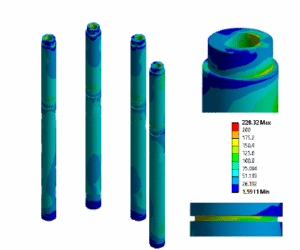
Introduction This case study presents the finite element analysis (FEA) and verification process conducted for the pressure-containing parts of the F35-340 actuator, developed by Actuator Technology Company. The primary goal was to demonstrate the structural integrity of the actuator under specified operating conditions and to ensure compliance with the requirements

Fatigue Assessment of the 28L Oil Separator
This case study presents the fatigue assessment of the 28L oil separator (Atlas part number 1625481501), performed to verify the vessel’s durability under cyclical internal pressure in accordance with the AD2000 S2 standard. The separator is subject to a cyclic pressure loading from atmospheric pressure up to 15 barg, which
Root Cause Analysis of Vibrating Regulator Valve 670FC005-VC
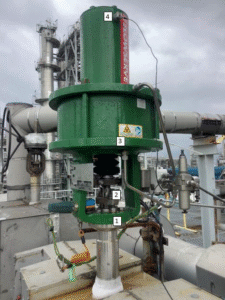
This project examines the root cause of increased vibrations observed in the control valve 670FC005-VC at Shell Pernis following its replacement with a new valve from a different manufacturer. The resulting vibrations led to a critical mechanical failure at the connection between the valve stem and the actuator. The objectives

Surge and Dynamic Stress Analysis of Foam Line AFW-023024
At BP Geel, a new extension of the fire protection system experienced operational failures during start-up due to surge effects. A similar incident with line AFW-023025 had previously prompted a surge analysis, leading to the current study focused on the adjacent foam system, line AFW-023024. The foam line, running nearly
Dynamic Stress Analysis of Foam Line AFW-023024
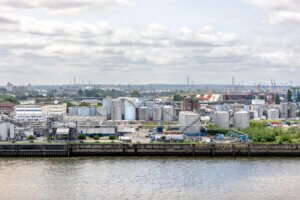
At the BP Geel facility, a previous failure of the fire protection system during start-up prompted a detailed investigation into surge effects within the network. The incident occurred on line AFW-023025, and subsequent studies identified hydraulic transients as the primary cause. Given the similar configuration and operating principle of the