
Table of Contents
Multiphase flow is a recurring challenge in process engineering, where multiple fluid phases—such as gases, liquids, or solids—interact within a single flow domain. These flows are notorious for their complexity, as their behavior is determined by the distribution of phases and the intricate forces at play between them. This complexity is further increased in industrial equipment, where factors such as heat and mass transfer and moving or rotating internals come into play.
Our experience shows that CFD is an essential and practical tool for understanding and optimizing multiphase flow systems. By leveraging CFD early in the design process, engineers can gain valuable insights into flow behavior, optimize performance, and make informed decisions on a relatively coarse model—often at a fraction of the cost and time required for full-scale experiments or high-fidelity simulations that are often conducted in later design stages.
In this article, we share our perspective on the sources of complexity in multiphase flows, discuss the unique challenges posed by dispersed and separated flows, and illustrate the benefits of CFD as a design tool with two recent case studies from our consulting practice.
Multiphase Flow: Why Is It Considered Complex?
Multiphase flow refers to the simultaneous flow of materials with different phases or chemical properties within the same system. The complexity of multiphase flow arises from several interrelated factors:
Diverse Flow Patterns and Regimes
Multiphase flows can manifest in a variety of flow patterns. In two-phase flows, on which much academic research has concentrated, these patterns include, bubbly, slug, churn, annular, and stratified flows. Each particular pattern depends on the relative fractions of each phase, flow orientation (horizontal, vertical or inclined), and the line operating conditions.

Vertical two-phase gas-liquid flow patterns (Weisman, 1983)

Horizontal two-phase gas-liquid flow patterns (Weisman, 1983)
For example, in a vertical pipe with a high liquid fraction and low gas content, a bubbly flow regime with discrete gas bubbles in a continuous liquid carrie is common. Conversely, high gas fractions can lead to annular flow, characterized by a high velocity has core with the liquid fraction confined to a thin film along the pipe wall. The in between patterns have more complex and less clearly defined dynamics.
It is important to note that relevant estimates for process parameteres such as heat and mass transfer rates, residence time, etc. can vary greatly depending on the flow pattern. Because of this, academic and industrial efforts have long concentrated on establishing flow classification schemes. One such example are flow pattern maps, that allow for predicting flow pattern based on component flow rates. These maps are however restricted in use to comparable geometries. Even then, transitions betweem adjacent regimes are often blurry and highly sensitive to process conditions, making prediction and control challenging.

Example flow regime map for horizontal Gas-liquid flow (Mandhane et al., 1974)
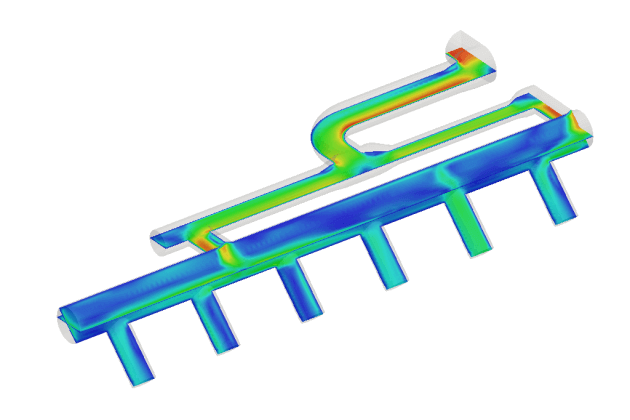
Using CFD for optimizing multiphase process engineering
Particles, Drops, or Bubbles in a Carrier Fluid
Phase Interactions
The distribution and interaction of phases is governed by a range of forces, including drag, lift, added mass, and interfacial tension. These forces can vary significantly depending on whether the flow is dispersed (i.e. particles, drops, or bubbles in a carrier fluid) or separated (distinct regions occupied by different phases). Coupling mechanisms between phases—such as particle accumulations altering local flow turbulence, which in turn affects the total particle distribution—add further layers of complexity.
Modeling and Predictive Challenges
Accurate modeling of multiphase flows requires selecting appropriate models for the expected flow physics and correctly capturing interfacial phenomena, such as wave formation and instabilities. Analytical estimates are rarely feasible, and experimental approaches can be costly and limited in scope. This is where CFD becomes essential to predict flow behaviour and enable process optimization.
Disperse Multiphase Flows: Particles, Drops, or Bubbles in a Carrier Fluid
One of the most common forms of multiphase flow in process engineering is dispersed flow, where particles, drops, or bubbles are distributed throughout a continuous carrier fluid. Several key interaction mechanisms determine the behavior of these dispersed phases:Flow-to-Particle Interactions
Drag, lift, and added mass forces arise due to velocity or acceleration differences between the carrier fluid and the dispersed phase.These forces are typically modeled for individual particles and then extended to collections of particles, with corrections for concentration effects.
Particle-to-Flow Interactions
At higher concentrations, particles can significantly alter the turbulence and flow structure, creating a feedback loop that affects both the carrier fluid and the distribution of the dispersed phase.
This is particularly important in regions where particle size is comparable to the characteristic length scale of the flow.
Particle-to-Particle Interactions
In dense suspensions or when particles are large relative to the flow, direct interactions between particles become significant, influencing clustering, agglomeration, and overall flow behavior.
Practical Example
In a helical coil reactor containing a gas flow laden with solid particles, CFD simulations revealed that the distribution of larger particles (e.g., 40 μm) is dominated by centrifugal forces, causing them to cluster near the outer wall, while smaller particles (e.g., 10 μm) are more evenly distributed due to the influence of turbulent fluctuations. This understanding is crucial for optimizing reactor design and ensuring efficient chemical reactions.
Separated Multiphase Flow: Continuous Fluid Streams Separated by Interfaces
In separated multiphase flows, each phase occupies a distinct region in space, and the interaction occurs at the interface between the phases.
The interface between phases is subject to interfacial friction due to varying component flow conditions and fluid properties. This can lead to the generation of waves, trigger hydrodynamic instabilities or promote phase entrainment. A common example is wave formation due to a high-velocity gas flow over a liquid interface (which for equal pressure loss per unit lenght moves at a much slower pace). For limited wave height, the momentum losses associated with interfacial friction can sometimes be modelled as an equivalent wall roughness.

Modeling Challenges
Accurate simulation of separated flows requires coupling of single-phase flow equations for each phase with appropriate interface conditions. These conditions must account for the expected dominant physical origin of interfacial friction, (e.g. wave formation) and possible phase transitions.
Application Example
The mixing of stratified liquids in a storage tank is a classic example of separated flow, where two miscible liquids with similar densities are initially layered and mixed by a recirculating jet. This mixing process is driven by both advective transport and turbulent dispersion at the jet plume interface and CFD can be used to predict mixing times and optimize jet nozzle orientation and outlet velocity.
Benefits of Employing CFD as a Process Design Tool
CFD has become a cornerstone of modern process engineering, offering a range of benefits that address the unique challenges of multiphase flows:
Insight into Complex Flow Behavior
CFD enables engineers to visualize and analyze complex multiphase flows that are otherwise difficult to predict using analytical or experimental methods. It provides detailed information on phase distribution, velocity fields, and interaction forces, supporting informed decision-making.
Early-Stage Design Optimization
Relatively simple CFD simulations can deliver valuable insights during the early stages of process development, highlighting critical process parameters and guiding design choices before costly physical prototypes or experiments are undertaken.
Flexibility and Scalability
CFD models can be tailored to the level of detail required, from coarse simulations for initial screening to high-fidelity models for final optimization. This flexibility ensures that computational resources are used efficiently.
Process Performance Optimization
CFD helps identify and optimize key factors affecting process performance, such as particle size, flow velocity, and equipment geometry. It supports the development of robust, efficient, and scalable processes.
When used this way, CFD can accelerate the design process and lower development costs. Depending on the level of modeling detail, it an allow for rapid evaluation of multiple design scenarios and operating conditions.
Case Study 1: Particle Distribution in Reactor Gas Flow
Objective
Optimize particle distribution in a helical coil reactor with gas flow laden with solid particles to ensure efficient chemical reactions.
Approach
Initial CFD simulations focused on flow-to-particle interactions only, as the intended particle concentration was low (0.1 vol%), with the intention to verify any critical flow behavior with more detailed simulations.
Two main forces influence particle distribution
- Centrifugal force (dominant for larger particles, driving particle distribution toward a concentrated cluster at the outer wall).
- Turbulent dispersion (has a more significant effect on smaller particles; promoting net particle transport from regions of high to regions of low concentration, i.e. wall to core).
Findings and Recommendations
- At current operating conditions, centrifugal forces clearly dominate the particle distribution from circa 20 μm particle diameter onwards. Smaller particle diameters, lower gas flow rates (up to a minimum treshold, to ensure sufficient turbulence intensity), and larger coil reactor radius improve the particle distribution.
- The client required complete flexibility in particle diameters, which was not feasible with the current reactor geometry, leading to a recommendation to consider alternative designs.
Takeaway
A limited-complexity CFD model provided insights early in the design process, which provided the client with a sense of direction for optimization. Note that more accurate simulations would change the recommendations made in any significant way.
Case Study 2: Mixing of Stratified Liquids in Storage Tank
Objective
Estimate mixing time required to obtain a homogeneous blend of two miscible liquids with similar densities, using a get recirculation system in a large storage tank.

Approach
A two-stage CFD simulation was employed to be able to generate results over a long timescale (~days) with computational efficiency:
- Simulate a steady-state velocity field for a single-phase mixture fluid.
- Solve a scalar transport equation for concentration over the fixed flow field, accounting for both advective and turbulent mixing.
The tank featured an internal recirculation jet nozzle to promote mixing, linked to the outlet flow characteristics via a cyclic boundary condition.
Findings and Recommendations
While advective mixing is the prime mechanism driving total required mixing time, turbulent dispersion can provide a significant increase in mixing rate, in particulara along the jet plume edges.
The client intended mixing ratio was monitored using a series of probes distributed throughout the simulation domain.
Potential optimizations included adjusting the jet nozzle orientation, increasing jet velocity, and optimizing the outlet location with respect to the inlet.
Outcome
The client was satisfied with the mixing time estimate as only minimal changes were required to implement the mixing process. The two-stage CFD approach enabled efficient long-term calculations and provided actionable recommendations for process improvement.
Conclusion
Multiphase flows are inherently complex due to the diversity of flow patterns, intricate phase interactions, and dynamic coupled effects. Dispersed and separated flows each present unique challenges that require advanced modeling and simulation techniques. CFD stands out as a powerful, flexible, and cost-effective tool for analyzing and optimizing multiphase processes, delivering actionable insights that drive better design decisions and process performance.
By leveraging CFD early in the design process, engineers can identify critical parameters, optimize equipment and operating conditions early. The case studies presented here demonstrate the practical value of CFD in real-world process engineering challenges, from optimizing particle distribution in reactors to enhancing mixing in storage tanks.
For organizations seeking to stay ahead in process optimization, adopting CFD as a core design tool is not just an advantage—it’s a necessity.