
Software
Upcoming webinar
Analysis of Surge problems with CAESAR II and BOSfluids 5.4 The webinar Together with Hexagon PPM, DRG is co-hosting a free webinar on Analysis of

Analysis of Surge problems with CAESAR II and BOSfluids 5.4 The webinar Together with Hexagon PPM, DRG is co-hosting a free webinar on Analysis of

DRG’s Richard Fawcett looks at the importance of designing for pressure surges in an LNG bunkering line. February 2017 In the February issue of LNG

Meeting the challenges of Oil & Gas The Oil & Gas and petrochemical field can be prone to difficulties when it comes to efficiency, flow

Bridging the gap between research and field work Dynaflow Research Group will be presenting two papers at the 3rd International Rotating Equipment Conference on September

Alba B3 platform installed – DRG performed surge analysis It is always nice to see your computer models becoming reality! DRG performed a surge analysis

DRG performs structural assessments on Heat Exchangers for Concentrating Solar Power plants The US Office of Energy Efficiency & Renewable Energy proclaimed 2014 ‘The year

Flow Assurance training course offers a valuable opportunity to learn from and seek advice from one of the foremost experts in Oil and Gas Flow

Presentations by keynote speaker Prof. Dr. ir. Ruud Henkes (Shell / TU Delft) and Dr. Andrew Jackson (Engys UK) The abstracts for the presentations by

Title: Vacuumatics: 3D Formwork Systems By Franciscus Antonius Augustinus Huijben One of the most important architectural trends of the last two decades is commonly referred

Titel: Computational Modelling of Particle Packing in Concrete By Huan He Physical particle packing is becoming a hot topic in concrete technology as more and

Titel: Porosity of Concrete – Morphological Study of Model Concrete By Jing Hu Porosity of Concrete has developed a comprehensive methodological framework for characterizing geometrical

Titel: Mesostructure of concrete Stereological analysis and some mechanical implications By Jianjun Zheng On the mesoscale, concrete can be considered as a composite material consisting

Benefit of computational simulation of a pulsation dampener compared to an analytical method Accumulators are used to reduce pressure pulsations from reciprocating pumps by adding

ON-DEMAND 🕖 30 MIN 🌏︎ ENGLISH Understanding and Mitigating AIV and FIV in Modern Plant Design David Tickner Senior Engineer Get instant access
ON-DEMAND 🕖 30 MIN 🌏︎ ENGLISH How To Predict Stresses From Slug Flows Daniëlle de Jong Senior Engineer Get instant access Free recording
ON-DEMAND 🕖 60 MIN 🌏︎ ENGLISH Building models using the import PCF file feature & model verification In BOSfluids Thijs Krijger Project Engineer

ON-DEMAND 🕖 60 MIN 🌏︎ ENGLISH Solving Vibrations In A Two-Phase Process Line Frank Bos Partner Get instant access Free. Recording + slide

ON-DEMAND 🕖 50 MIN 🌏︎ ENGLISH Surge and dynamic stress analysis for an offshore wind farm using BOSfluids Mark Groen Software Lead Engineer

ON-DEMAND 🕖 25 MIN 🌏︎ ESPAÑOL Integración de BOSfluids con Caesar II y otros programas de tensión de tuberías Uri Peker Engineer Get instant
ON-DEMAND 🕖 35 MIN 🌏︎ ENGLISH BOSfluids integration with CAESAR II and other pipe stress programs Ryan Metcalf Manager USA Get instant access

The client is operating multiple ammonia plants with similar cooling water systems made of GRE. Last year, failures were discovered in buried GRE components—specifically, an elbow and a tee—at one of the older plants. A surge analysis conducted by Dynaflow Research Group revealed that these failures were due to an

A new firewater (FW) system is being designed for a Green Hydrogen Elements facility. The plant spans a large area of approx. 2 x 1.5 km and contains multiple critical areas. The piping material is Fiber Reinforced Plastic (FRP). The main firewater ring is of DN250 and DN300 piping. The

A client designed a foam piping system that covers the three tanks in a tank pit in the harbor. The firewater system is directly connected to the general water supply. The main pipeline passes through the foam house where the water is mixed with foam. A manifold divides the mixture

A manufacturer of pulsation dampers requested Dynaflow Research Group to verify the performance of one of its discharge silencer designs in combination with a double rotary lobe gas blower by means of a pulsation study. The scope of the study consisted of a connecting straight pipe spool and the silencer

A fatigue analysis has been done for a reactor feed pressurization drum. The vessel operates under cyclic pressure ranging from 25 psig to 200 psig (1.7 – 13.8 bar), with a design life of more than 5 million cycles. Additionally, it is subjected to 200 full-range cycles from atmospheric pressure

A Glass Reinforced Epoxy (GRE) fire water header, installed on a Liquefied Natural Gas (LNG) jetty, comprises DN700 pipes and is subjected to seismic accelerations. Due to the jetty’s structure, the seismic accelerations provided by the client vary significantly along its length. The fire water header must be evaluated for

The above-ground seawater supply header is designed to transport seawater from two tie-ins in a discharge manifold of the seawater pumps to AGA. A comprehensive static stress analysis was necessary to determine the stress levels within the Glass Reinforced Epoxy (GRE) line. Additionally, it was crucial to define a support

At an LNG terminal, an unexpected settlement of 12 inches of soil, containing several sections of Vacuum Insulated Piping (VIP), occurred. Because the above-ground pipe supports were unaffected by the settlement, the differential displacement between the above-ground supports and the underground soil resulted in plastic deformation of some of the
This case study explores the static stress assessment of a continuous steam generation system (SGS) using finite element method analysis. The focus is on a small-diameter plant that utilizes molten salt to generate steam in a heat exchanger at a solar plant facility. The plant includes four sequential components: an
This case study presents a comprehensive review of gasholder sizing within a cokes gas network. The primary objective is to evaluate the impact of adjusting the gasholder size on reducing annual flaring volumes and providing a buffer for short-term discrepancies between cokes gas production and consumption. The study explores various

DRG was engaged to conduct a stress analysis for two sulphur recovery burners, adhering to ASME VIII Division 1 Boiler and Pressure Vessel Code. This analysis involved traditional Division 1 calculations complemented by Finite Element Analysis (FEA) to evaluate the impact of nozzle loads on critical junctions. Additionally, an assessment

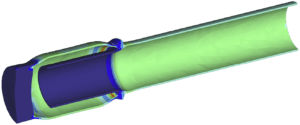
This case study focuses on the finite element analysis (FEA) conducted for a filament wound coupler designed for 42-inch centrifugal cast fiberglass pipes. The objective was to evaluate the performance of the fiberglass coupler under various conditions to ensure it meets the required specifications. Analysis The filament wound couplers (FWC)

A comprehensive finite element method (FEM) analysis was conducted on a molten salt/oil heat exchanger used in a solar plant facility. This heat exchanger is one of three identical units connected in series, operating under high pressures and temperatures with significant pressure and temperature cycling throughout day and night. To

In maintenance operations involving a vacuum tower approximately 50 meters in height, additional scaffolding is necessary. This scaffolding introduces increased wind loads, which, in turn, can elevate compressive stresses at the base of the tower. Such elevated stresses may lead to potential buckling or localized high stresses within the tower,
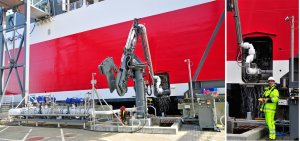
At a Liquefied Natural Gas (LNG) plant, a new LNG bunkering line is being constructed to supply ships with liquid LNG. This project involves the installation of new piping, which will be completed in multiple phases. This case study focuses on evaluating the material stresses, as well as the loads

Since the early 1980s, cracks have been observed in the off-gas cleaning section of the ethylbenzene hydroperoxide (EBHP) reaction unit. To address environmental concerns, EBHP must be removed from the off-gas before flaring. This process involves absorbing EBHP in norit beds within norit vessels, followed by cleaning the vessels with

Finite Element Analysis (FEA) is conducted on the skirt-to-head weld of an Acetylene Converter to evaluate the impact of a hot-box installation. Positioned on the interior side of the skirt in the skirt-to-head weld area, the hot-box aims to mitigate thermal bending stresses within the joint. The thermal analysis is

This case study examines a stress analysis conducted in accordance with ASME VIII Division 1 Boiler and Pressure Vessel Code for a main burner system. The burner in question features a vessel with an air inlet nozzle and connects to a “gun” with both a fuel gas inlet and an

This case study explores the findings from a detailed flow analysis conducted on three different wastewater treatment reactors. In these reactors, component ‘A’ is intended to be removed from the wastewater stream by converting it into component ‘B’. However, the original reactor design exhibited a significant parasitic reaction, where ‘A’

This case study examines the findings from a comprehensive flow analysis conducted on two identical suction lines connected to VIS Breaker Bottom Pumps. The existing Bottom Pumps were slated for replacement with new models. According to the pump supplier’s specifications, a minimum straight length of five times the diameter (5D)

A comprehensive stress analysis was conducted on an assembly comprising two burners and two interconnected chambers. Each burner generates a substantial flame, which combusts waste gas within the chambers. The top chamber is stacked atop the bottom chamber, with both chambers connected by piping that channels flue gas to the

DYNAFLOW RESEARCH GROUP (“DRG”) Enters into Reseller Agreement with Quality Professional Software (“QPS”) RIJSWIJK, The Netherlands – January 24, 2024 (Dynaflow Research Group BV) –

Dynaflow Research Group and Seawind Ocean Technology announce collaboration focusing on technical readiness of floating offshore wind applications in the Mediterranean Sea. This landmark partnership