
Table of Contents
Control Systems
Control systems are fundamental to the operation and optimization of fluid dynamics in engineering applications. In BOSfluids, control systems are designed to adjust the properties of flow elements—such as valves and pumps—in response to changes in flow conditions. These systems are composed of two main components: sensors and controllers. The sensors continuously monitor key parameters within the system, while the controllers process this information and make real-time adjustments to maintain desired performance and stability.

Sensors
Sensors are the eyes and ears of any control system. In BOSfluids, a variety of sensors are employed to measure critical flow properties, including:
- Pressure
- Flow rate
- Mass flow rate
- Flow velocity
- Liquid height
The placement of these sensors is strategic: pressure sensors are typically located at nodes within the piping model, while flow-related measurements are taken at pipe elements. This configuration ensures comprehensive monitoring of the system’s state, enabling precise control actions.
Analogue vs Digital
A key distinction in sensor technology is between analogue and digital sensors. The primary difference lies in the sample period—the interval between successive sensor output signals:
- Analogue sensors provide a continuous signal, offering a smooth and uninterrupted representation of the measured parameter over time.
- Digital sensors operate by sampling the signal at discrete intervals, resulting in a step-like output that consists of individual data points at regular time intervals.
This difference is crucial for control system design, as it affects the resolution and responsiveness of the feedback loop.

Controllers in BOSfluids
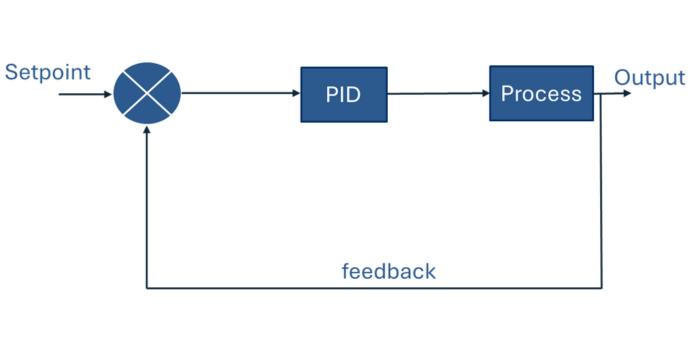
Controllers in BOSfluids are responsible for regulating the operation of valves and pumps. By processing the data received from sensors, controllers adjust parameters such as pump speed and valve opening to maintain optimal flow conditions. This closed-loop regulation is essential for ensuring that the system responds appropriately to disturbances and maintains stability under varying operational scenarios.

What is a PID Control System?
- Proportional (P)
- Integral (I)
- Derivative (D)
Form of PID
Where:
This equation encapsulates the combined effect of the proportional, integral, and derivative terms, each contributing uniquely to the control action.
Proportional Controller
Benefits:
- Fast response to changes
- Damps oscillations
Limitations:
- Leaves a persistent (steady-state) error
- High gain can cause instability
Integral Controller
Benefits:
- Eliminates steady-state error
- Ensures the system reaches the setpoint
Limitations:
- Can increase oscillations
- May slow response to sudden changes
Lorem ipsum dolor sit amet, consectetur adipiscing elit. Ut elit tellus, luctus nec ullamcorper mattis, pulvinar dapibus leo.
Derivative Controller
Benefits:
- Proactively dampens oscillations
- Improves system stability
Limitations:
- Does not eliminate error on its own
- Highly sensitive to noise
Building a Control System
Designing an effective PID control system is a balancing act. The recommended approach is to:
- Start with a dominant proportional component to ensure quick response and basic stability.
- Add the integral component to eliminate steady-state error, being cautious of introducing oscillations.
- Introduce the derivative component to further dampen oscillations and improve responsiveness to rapid changes.
This stepwise tuning allows for a stable, responsive, and accurate control system tailored to the specific dynamics of the BOSfluids application.
Transfer Function
Transfer Function - Zero Order
This model does not account for time delays or dynamic behavior, making it suitable for systems with instantaneous response.
Transfer Function - First Order
A first-order transfer function introduces a time constant, representing systems with a delayed response:
- : Time constant (determines response speed)
- : Gain
- : Bias
The time constant dictates how quickly the system responds to changes in the input; larger values result in slower responses.
Transfer Function - Second Order
Second-order systems are common in applications where oscillations and damping are significant, such as mechanical vibrations and fluid dynamics. The damping ratio is critical for determining whether the system is underdamped, overdamped, or critically damped.
Conclusion
By understanding and applying these principles, engineers can leverage PID controllers in BOSfluids to achieve precise, stable, and efficient control of complex fluid systems. The careful selection and tuning of sensors, controllers, and transfer functions are key to optimizing performance and ensuring robust operation in real-world scenarios.