
Excessive vibrations were detected in the discharge piping of compressor C801 at BP Rotterdam. The observed vibration frequencies corresponded to the compressor’s running speed and its harmonics, indicating the compressor as the primary excitation source. This prompted an in-depth technical investigation due to concerns over the integrity and reliability of the piping system and its supporting structure.
The vibrational phenomena were considered critical both for operational safety and for preventing fatigue-induced failures. The objective was to diagnose the root cause, characterize the dynamic behavior, and provide practical mitigation measures.
Methods and Modeling
Dynamic Modeling Approach
A comprehensive flexibility model of the discharge piping was developed using ISOtracer, reflecting the as-built arrangement observed during a site survey. The model was transferred to Caesar II for modal and harmonic analysis. The surrounding steel support structure, including key beams and columns, was incorporated to capture the coupled behavior between the piping and its supports. Onsite observations guided refinements where the actual routing deviated from design isometrics.

Vibration Measurements
Seventeen strategic locations were selected for vibration measurement, based on calculated mode shapes likely to be excited by compressor-induced pulsations. Measurements were taken with triaxial accelerometers using a Bently Nevada Scout 240, recording acceleration time histories over 16-second intervals at each site. Data analysis was performed using custom Python scripts, enabling comparison of measured responses with simulated mode shapes and identification of dominant vibration modes.


Driven Oscillation and Force Estimation
Driven oscillation analyses were conducted to replicate field conditions and estimate the magnitude of dynamic forces required to produce the observed displacements. Recognizing that perfect frequency matching between model and system is rarely possible, a frequency sweep around the expected resonance was used to bracket the actual response. Pressure pulsation studies indicated a maximum differential of 0.37 barg in the main pipework; a harmonic force of 255 N at 5.9 Hz applied to the 6” header reproduced the measured displacement amplitudes, corresponding to a pressure difference of 0.17 barg over the straight section.
Results and Discussion
Vibration Measurements And Severity
The dominant vibration frequency was 6.2 Hz, matching the compressor’s running speed (372.3 RPM), with significant peaks at harmonics. All observed piping vibration modes corresponded to these harmonics, confirming compressor-induced pulsations as the excitation mechanism. Using the VDI-3842 (2014) criteria, vibration levels at all measurement locations exceeded the ‘design’ threshold, with several sites (notably locations 13 and 17) surpassing the ‘correction’ and even ‘danger’ thresholds. While not all excessive vibrations necessarily indicate imminent failure, the levels observed at location 13 warranted immediate corrective measures.

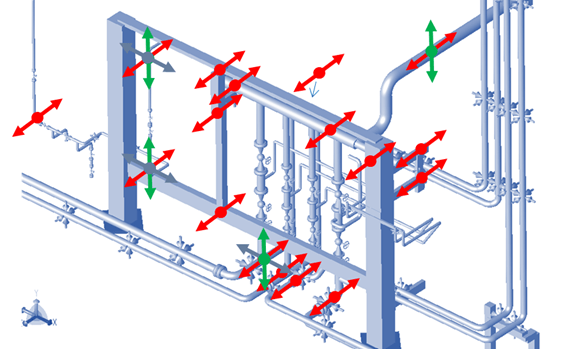
Directional analysis revealed that the system’s vibration was predominantly in the Z-direction, supporting the hypothesis that unbalanced forces in the 6” header were the principal driver.
Dominant vibration direction for each of the measurement locations:
Modal Analysis
Modal analysis identified a dominant mode at 5.9 Hz, where the entire piping system oscillated in-phase, and a secondary mode at 11.9 Hz involving out-of-phase movement of the manifold’s top and bottom. The 5.9 Hz mode closely aligned with the measured excitation, rendering the system especially susceptible to resonance under compressor operation.
Dynamic simulation applying a harmonic force to the 6” line confirmed that a force magnitude of 255 N at this frequency replicated the field-measured displacements, validating the analytical model and force estimation.

Mitigation Measures
Structural bracing was the preferred mitigation strategy due to the coupled motion of the piping and its steel support frame. Five bracing layouts (A–E) were evaluated for their effectiveness:
- Layout A: Diagonal beam from column to ground below manifold attachments.
- Layout B: Addition of a large horizontal beam at manifold height, increasing mass and stiffness.
- Layout C: Additional diagonal beam on the opposite column.
- Layout D: Two cross beams at the 6” line supports (most effective).
- Layout E: Isolated effect of cross beams on the 6” supports without other bracing.
Harmonic analysis demonstrated that layouts A and E shifted the resonance frequency marginally upward (6.4 Hz), reducing the amplitude but not eliminating resonance risk, as the new resonance still fell within the typical compressor speed variation range (5.7–6.7 Hz). Layout B moved the resonance out of the excitation window (to ~8.7 Hz), significantly reducing vibration risk from compressor harmonics. Layouts C and D provided incremental improvements, with layout D reducing displacements at critical locations (e.g., location 17) by a factor of 2. Layout E, while effective for some frequencies, provided only a 1.7-fold reduction across the key frequency range, insufficient for guaranteed compliance under all operating conditions.

Conclusions
The study confirmed that excessive piping vibrations in compressor C801’s discharge line are caused by compressor-induced pulsations, exciting a natural mode of the piping-support system near 6 Hz. The most significant unbalanced forces originate in the 6” header, with the entire structure oscillating predominantly in the Z-direction. Modal and harmonic analyses, validated by field measurements, allowed accurate quantification of dynamic forces and provided the basis for targeted structural modifications.
Among the mitigation strategies, layout D—featuring cross beams at the 6” pipe supports—proved most effective in reducing vibration amplitudes at the critical excitation frequencies. However, the effectiveness of any mitigation depends on the precise alignment of excitation and natural frequencies, which may vary due to operational changes.
Recommendations
It was recommended that BP Rotterdam conduct a feasibility assessment of the proposed bracing layouts, particularly layout D, to determine constructability and integration within existing plant constraints. The final bracing design should be validated through as-built dynamic analysis. Additionally, locally restraining the flexible 1” line at location 13 will mitigate excessive vibration there, and supporting the four discharge lines from the floor rather than the walkway will further constrain unwanted motion and reduce vibration transmission.
Continued monitoring post-implementation is advised to ensure that dynamic responses remain within safe operating limits and that new modes or coupled responses are not inadvertently introduced.