
This case study presents the findings of a comprehensive pipe stress analysis of several tank lines following a leakage incident at an expansion joint. The analysis was initiated after segments of the tank lines were replaced with new routing. Upon operation of the system, a leak was detected at the expansion joint connected to the tank, prompting a detailed investigation into the system’s mechanical behavior.
System Description and Modelling Approach
The piping network under review comprises both legacy and newly installed sections, each with distinct support arrangements and pipe dimensions. The system is situated outdoors in Amsterdam, subjected to local environmental loads, with connections to three storage tanks situated behind a common dike. The analysis is performed according to the EN 13480 design code for metallic industrial piping and used CAESAR II v13 for stress modeling.
Geometry and Piping Properties
The geometry for stress modeling was established using existing CAESAR II input data for the original piping and isometric drawings for the new sections, verified through on-site inspection. The piping material is 1.0345S-16-200, with a 1 mm corrosion allowance, and is designed for a fluid density of 750 kg/m³. Pipe diameters in the new sections range from DN25 to DN500, with wall thicknesses up to 10 mm for the largest sizes. The design pressure is 11 barg, with temperatures ranging from -10°C to 50°C. The system includes a mixture of steel-on-steel and steel-on-Teflon supports, each with respective friction coefficients of 0.3 and 0.1, respectively.
Equipment and Components
Expansion joints, essential for accommodating thermal and mechanical movements, were modeled with flexibility and tie rod characteristics per field measurements. Two modeling scenarios were developed to account for uncertainties in tie rod gap settings: one with zero expansion gap and one with a neutral gap allowing symmetric movement. Flanges were evaluated using a combination of the Kellogg’s equivalent pressure method and the Koves factor.
Nozzle loads were conservatively estimated by modeling the nozzles as rigid anchors; allowable loads were determined by finite element analysis using NozzlePro, with further conservatism introduced by assuming non-circular reinforcement pads as minimal-radius circles and discounting gusset strength.
Environmental and Operational Loads
Wind and snow loads were applied based on local meteorological data, with wind speeds up to 30.74 m/s (at 20 m elevation) and a snow load of 0.7 kN/m². Soil settlement under the tanks was simulated with a -30 mm vertical displacement at the nozzles, and a 19 mm radial displacement was used to model tank expansion upon filling.
Leakage Investigation
The leakage at the expansion joint to the tank was investigated through several hypotheses:
- Over-Restraint: The new piping sections were found to have U-bolt supports that excessively restricted movement, leading to high stresses during tank radial expansion. It was determined that converting some guides to rest supports would alleviate these stresses.
- Thermal Expansion: Analysis indicated that the thermal expansion of the header, particularly in the longest line, induced significant bending moments on expansion joint flanges, risking overstress. Implementing limit stops at designated points mitigated these moments and brought flange stresses within allowable limits when applying the Koves factor.
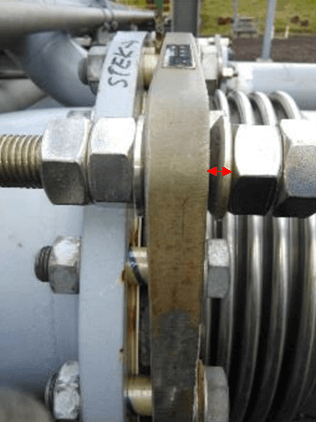
- Tie Rod Gaps and Bending: Site inspections revealed asymmetric gaps in expansion joint tie rods, indicative of high bending moments. This was attributed to misalignment, possibly aggravated by soil settlement and improper tie-rod tightening (i.e., uneven torque). The study recommended a standardized tightening protocol to ensure even force distribution across the expansion joint.
- Dynamic Effects: Discoloration and scratch marks at pipe supports suggested dynamic movement, potentially due to water hammer events, as evidenced by displacement directions inconsistent with thermal expansion alone. The installation of axial stops at specific locations was recommended to control transient-induced movement and improve system stability.


Analysis Results
Pipe Stresses
Post-mitigation, all pipe stresses were verified to remain within EN 13480 allowable limits in all loading scenarios.
Flange and Nozzle Checks
Flanges, particularly those near the tank connections and expansion joints, were brought within allowable pressure equivalence limits due to the support modifications. Nozzle load evaluations showed that, except for a single direction moment overstress (by 7%) in the main suction line under a specific soil settlement case, all loads were within conservative allowable limits. The isolated overstress was deemed acceptable because it occurred in only one direction, with all other components well below 15% of their allowable loads.
Expansion Joint Performance
The combination of revised support arrangements and a recommended tie-rod tightening plan lowered both static and dynamic loading concerns for the expansion joints. Properly set tie-rod gaps and evenly distributed preload are expected to minimize flange bending and prevent future leakage incidents.
Conclusions and Recommendations
The comprehensive stress analysis revealed that the original support scheme, in conjunction with the new piping sections, lead to excessive loads. By implementing the proposed support modifications and adopting a systematic tie-rod tightening protocol, all critical stress points were effectively managed, ensuring system compliance with EN 13480 and enhancing operational robustness.
It is recommended that the client coordinates with the expansion joint manufacturer to formalize a tie-rod adjustment procedure, guaranteeing even load distribution in the unloaded state. Additionally, ongoing monitoring for dynamic effects and regular inspection of support conditions are advised to maintain the integrity of the tank line system.