
On the Goliat Floating Production Storage and Offloading (FPSO) unit, significant vibration and cavitation phenomena were observed downstream of control valve 71PV1103 on the minimum flow line of pump B during maximum flow conditions. Additionally, pressure surges were reported during system start-up through this minimum flow line. Such issues posed risks of fatigue damage to the piping system and the caisson nozzle intersection, raising concerns about operational safety, system reliability, and long-term asset integrity.
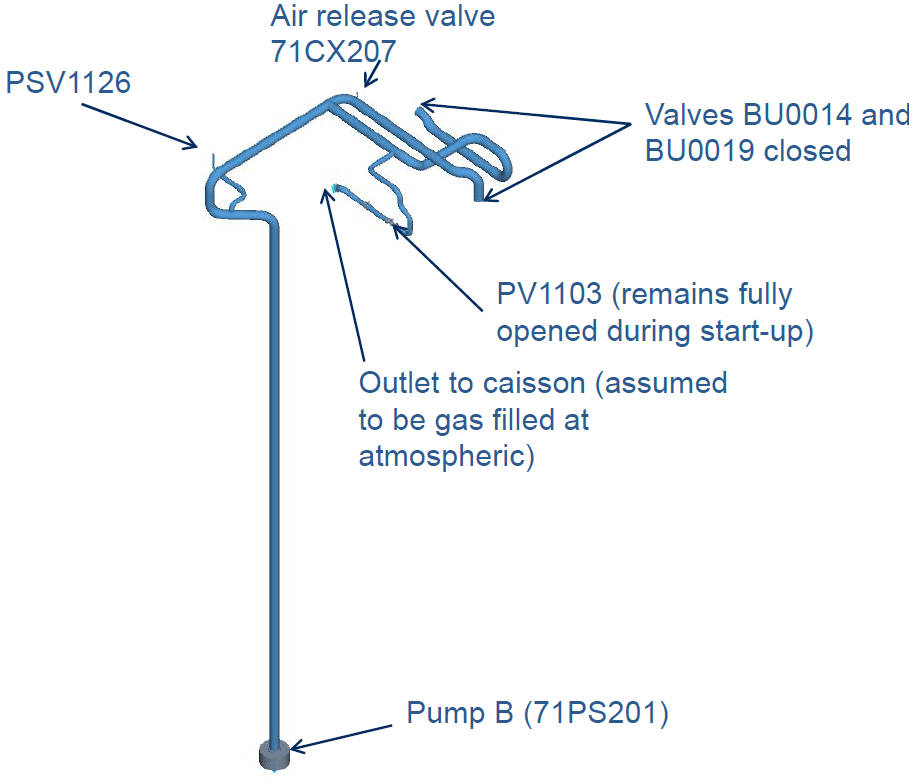
The primary objectives of this investigation were to perform a detailed surge analysis to characterize unbalanced forces during start-up, determine the root cause of flow-induced vibrations, propose viable mitigation strategies, and provide a realistic assessment of fatigue risks to critical piping components. The analysis also accounted for a recent modification: the increase in the control valve’s capacity from a flow coefficient (Cv) of 531 to 1090 (usgpm/psi) to address operational constraints.
System Overview and Operational Scenario
The relevant process section involves pump B, its associated minimum flow line, control valve 71PV1103, and the discharge to a caisson assumed to be gas-filled at atmospheric conditions during start-up. During the start-up sequence, the line to the dump caisson is initially empty. Upon activation, the pump rapidly fills the line, expelling air through the caisson nozzle and air release line. Entrapped air, if present, acts as a compressible surge vessel, affecting subsequent pressure dynamics.
Once water reaches the control valve, the system experiences a sharp increase in flow resistance, which induces a rapid pressure spike (waterhammer effect). The magnitude and duration of this spike are influenced by the flow velocity, the volume of entrapped air, and the specific characteristics of the water front impacting the valve. The control valve’s increased capacity, intended to accommodate higher flows, significantly altered these dynamics.
Analysis of Surge and Waterhammer Effects
Surge simulations demonstrated that with the original control valve (Cv = 531), the system experienced peak pressures up to 41–42.6 barg during start-up. After the valve modification (Cv = 1090), peak pressures were reduced to 19–22.5 barg. Despite the reduction, these transient pressures remained substantial, with the potential for significant unbalanced forces on the piping: approximately 205 kN for the original valve and 105 kN for the upgraded valve.

The time required for priming (the moment the water front reaches the control valve and resistance is applied) was shown to critically affect surge magnitude. A steeper, more abrupt water front (shorter priming time) results in higher peak pressures and forces, whereas a more gradual front (longer priming time) mitigates these effects. However, precise control of priming time is challenging due to system uncertainties, such as air entrapment and flow distribution.
Root Cause of Flow-Induced Vibrations and Cavitation
Detailed flow analysis identified that the observed vibrations downstream of the control valve were primarily induced by flow instabilities resulting from cavitation. Cavitation, the formation and subsequent implosion of vapor bubbles when local static pressure drops below fluid vapor pressure, was confirmed as a likely occurrence in the valve’s vena contracta (the point of minimum pressure and maximum velocity downstream of the valve).
The analysis applied the cavitation number methodology, relating upstream pressure, vapor pressure, and the net pressure drop across the valve. Calculated cavitation numbers were 1.06 (Cv = 531) and 1.13 (Cv = 1090), both below typical critical values for globe-type valves with cage trims, corroborating a strong likelihood of cavitation for both configurations. Experimental data for similar valves supported this conclusion.
Mitigation Strategies and Recommendations
To address these critical issues, several engineering interventions were evaluated. The most effective solution identified was the introduction of an orifice at the caisson flange downstream of the control valve. This modification increased backpressure at the valve, thereby raising the local cavitation number to 3.5 in simulations. As a result, cavitation was shifted downstream to the orifice, where its impact would be less detrimental—any resulting vapor bubble implosions would occur within the caisson, minimizing the risk of vibration or damage to sensitive piping.
With the orifice (inner diameter 160 mm), the maximum achievable flow rate through the minimum flow line was approximately 2100 m³/hr, with a pressure drop of about 5 bar over the control valve and 11 bar over the orifice. While this intervention introduces additional waterhammer effects (maximum pressure of 23.3 barg and unbalanced forces of 40.7 kN), these are more manageable than the original scenario and do not pose significant risk to system integrity.
For further optimization, distributing the total required pressure drop across multiple orifices (three or four in series) was considered. Such a configuration could potentially eliminate cavitation entirely, though it would require additional flanges and piping space.
Alternative strategies included adjusting the pump start-up sequence to reduce initial flow rates and surge magnitudes, and exploring alternative valve designs with lower experimentally determined critical cavitation numbers. However, the existing cage-type globe valve was already near optimal for cavitation resistance, limiting the practical benefits of valve replacement.
Assessment of Fatigue and Structural Integrity
The fatigue impact on the downstream spool and caisson nozzle intersection was assessed by analyzing the magnitude and frequency of unbalanced forces generated by surge and cavitation events. The reduction in peak forces following the introduction of the orifice and/or optimized start-up procedures was expected to significantly lower the risk of fatigue damage, thus extending the service life of critical piping components.
Conclusions
The root cause analysis and flow simulations for the Goliat FPSO minimum flow line identified surge-induced waterhammer and cavitation downstream of control valve 71PV1103 as the primary sources of vibration and pressure transients. The increase in control valve capacity reduced, but did not eliminate, these risks. Introducing an orifice at the caisson flange provided an effective means of increasing backpressure, raising the cavitation threshold, and displacing harmful cavitation effects into a less sensitive section of the system. This solution, combined with possible flow rate adjustments during start-up, constitutes a robust mitigation strategy that addresses both immediate operational risks and long-term fatigue concerns.
Implementing these recommendations will require additional engineering analysis to optimize orifice sizing and configuration for the specific operational envelope. Nevertheless, the insights from this study offer a clear path forward to ensuring safer, more reliable operation of the Goliat FPSO’s minimum flow system, with reduced risk of vibration-related failures and extended component longevity.