
A pulsation analysis to API 618 Design Approach 1 checked the proposed dampener bottles of onshore and offshore reciprocating compressors against a guideline of 70 percent of the allowable pulsation levels. All proposed bottles gave levels within the API 618 allowable. At the line connection nozzle, only the offshore discharge level, at 72 percent of allowable, was above the guideline.
Dampener Bottle Functions and Compressor Configurations
The onshore machine is a two-stage compressor with two double-acting cylinders, one serving the first stage and the other the second stage. The offshore machine is a single-stage compressor with double-acting cylinders, and both cylinders act in parallel. Two dampener bottles are connected to each cylinder nozzle, one on the suction side and one on the discharge side. On the onshore machine, the suction sides of the double-acting cylinders are interconnected through a gas passage, and the same applies to the discharge sides. On the offshore machine, the suction sides are interconnected through a gas passage.
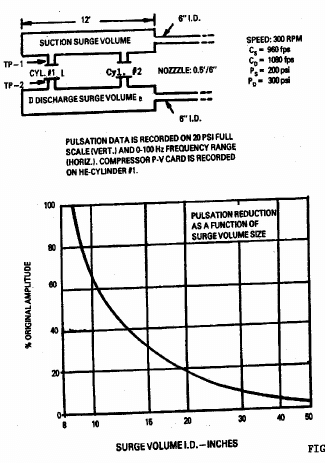
The bottles act as a surge volume (the windkessel function) and as a dampener or muffler that reduces transmitted pressure waves. At low frequencies the surge volume acts as an acoustic capacitance, and a large enough volume will theoretically attenuate the acoustic wave amplitudes to any desired degree. Economic considerations limit the bottle size and hence the overall attenuation that can be achieved. API 618 gives a recommended minimum surge volume at the compressor suction and discharge, related to the total net displaced volume per crankshaft revolution of all cylinders manifolding into that volume.
The muffler function relies on gas expansion at the change in cross-section between the connected pipe and the bottle. The damping efficiency depends on the ratio of the bottle and pipe cross-sectional areas and on the bottle length relative to the acoustic wavelength. Maximum attenuation occurs at bottle lengths of λ/4 + n × λ/2. Where the bottle length equals an integral multiple of half the acoustic wavelength (l = n × λ/2), the volume attenuation is zero. If the acoustic frequency corresponding to this bottle resonant condition is close to a compressor harmonic, the pulsation amplitudes at that frequency may increase.
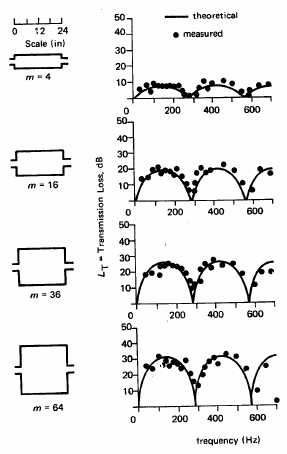
To reduce the chance of acoustic resonance, API 618 paragraph 3.9.2.2.2 indicates that the surge bottle length should be minimised and that the aspect ratio (L/D) of a single cylinder surge volume bottle should not exceed 4. The study selected a target aspect ratio of 3.
Pulsation Analysis to API 618 Design Approach 1
The scope of the analysis was limited to bottle design. The analysis followed API 618, fourth edition, Design Approach 1, which corresponds to item M1 and is completed by a simplified version of item M2, in which the connected piping is simulated by an endless line (no reflections). The piping system is not part of Approach 1.
The client proposed the bottle sizes, which follow revision 5 of the client drawings. For each proposed size, the pulsation levels were analysed at the compressor cylinder flange and at the line connection flange of the bottle, and compared with the API 618 allowable levels. The verification used paragraph 3.9.2.2.3 for the cylinder flange and paragraph 3.9.3.5 for the line side. As a guideline, the pulsation levels were to be limited to 70 percent of the allowable levels. The bottle sizes were compared with the API 618 recommended minimum.
The results for the proposed bottles are for compression and expansion as a polytropic process with a polytropic coefficient k = 1.2. The supporting tables also contain results for an isothermal process (k = 1), which gives lower pulsations than the polytropic process. In reality, the process lies between k = 1.2 and k = 1.
For the onshore compressor, the analysis was repeated for two alternatives with smaller bottles, referred to here as alternative 1 and alternative 2.
Pulsation Levels of Proposed and Smaller Dampener Bottles
All proposed bottles are larger than the API 618 recommended minimum size, and all gave pulsation levels within the API 618 allowable levels.
On the onshore compressor, the pulsation levels were 40 percent of API at the stage 1 suction (bottle size 2.3 times API), 44 percent at the stage 1 discharge (2.2 times), 37 percent at the stage 2 suction (2.3 times) and 56 percent at the stage 2 discharge (2.3 times). On the offshore compressor, the levels were 58 percent at the suction (2.2 times API) and 72 percent at the discharge (1.5 times).
The proposed bottles met the 70 percent guideline at the line connection nozzle, except at the offshore discharge nozzle. There the level was 72 percent of allowable, which is 2 percentage points above the guideline.
For the smaller onshore bottles, the results were as follows. Alternative 1 gave pulsation levels of 73 percent of API at the stage 1 suction (bottle size 1.22 times API), 59 percent at the stage 1 discharge (1.61 times), 71 percent at the stage 2 suction (1.17 times) and 72 percent at the stage 2 discharge (1.8 times). Alternative 2 gave 89 percent at the stage 1 suction (1.0 times), 67 percent at the stage 1 discharge (1.4 times), 85 percent at the stage 2 suction (size ratio not given) and 80 percent at the stage 2 discharge (1.6 times).
All bottles result in pressure pulsation levels within the API allowable figures.
Pulsation Level Against Bottle Size on the Onshore Compressor
On the onshore compressor, the stage 1 suction bottle gave 40 percent of allowable at 2.3 times the API 618 minimum size, 73 percent at 1.22 times (alternative 1) and 89 percent at 1.0 times (alternative 2). The 89 percent is within the API 618 allowable level and above the 70 percent guideline.
Dampener Bottle Pulsation Analysis: Frequently Asked Questions
What aspect ratio should a surge volume bottle have under API 618?
API 618 paragraph 3.9.2.2.2 indicates that the surge bottle length should be minimised and that the aspect ratio (L/D) of a single cylinder surge volume bottle should not exceed 4. The study selected a target aspect ratio of 3.
How does an API 618 Design Approach 1 analysis model the connected piping?
Design Approach 1 corresponds to item M1 and is completed by a simplified version of item M2. In that version the connected piping is simulated by an endless line, which means no reflections. The piping system is not part of Approach 1.
What happens to pulsation levels when dampener bottles are made smaller?
On the onshore two-stage compressor, the pulsation level at the stage 1 suction was 40 percent of the API 618 allowable at a bottle size of 2.3 times the API 618 minimum. It was 73 percent at 1.22 times and 89 percent at 1.0 times. The 89 percent is within the allowable level and above the 70 percent guideline.