
Recently, fatigue cracks were discovered in the first-stage discharge line’s small-bore instrumentation branches of a hydrogen compressor. Initial investigations pointed to excessive out-of-plane vibrations as the primary driver of these failures. While the system was originally installed in 1995 with a pulsation study, and further axial supporting was added in 2011, recurrent fatigue issues necessitated a comprehensive evaluation of all 15 branches.
The objective of this study is to assess the fatigue risk of all existing branches using site-specific vibration data, validate the effectiveness of existing gussets, and propose both intermediate and robust long-term solutions to ensure mechanical integrity.
Background and Modelling Data
The study encompasses three compressors (K1001A, B, and S). To simulate real-world conditions, 3D stress models were developed and “tuned” against RMS velocity measurements captured on-site.
- Key Modelling Parameters:
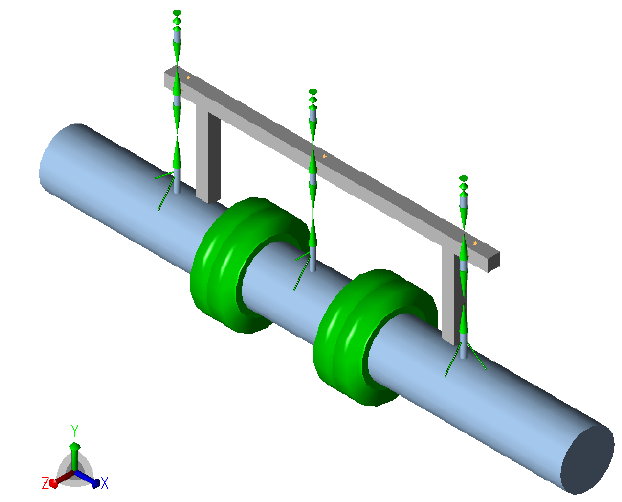
- Structural Integration: The models include the header section, the small-bore piping, and the supporting structural frames (50x50x6 mm angle profiles).
- Boundary Conditions: Header displacements were applied to the model ends to simulate system-wide vibration.
- U-Bolt Connectivity: Despite appearing tight, U-bolts were modeled as lateral restraints only, as they offer negligible resistance to rotation or axial movement.
- Damping Tuning: Damping coefficients ($\xi$) were adjusted to ensure the model’s Dynamic Load Factor (DLF) matched the peak displacements observed in the field.
Methodology and Checks
A multi-step analytical approach was utilized to identify the relationship between vibration frequencies and mechanical stress.
- 1 Frequency Identification
The team converted RMS velocities to peak displacements (s) using the relationship:
Critical frequencies were identified by comparing the relative displacement between the header and the frame. High differential movement (noted significantly at 20 Hz) indicates high bending stress.
Fatigue Assessment (ASME VIII-2)
Stress amplitudes were compared against the ASME B&PV VIII-2 fatigue curve for A106 B carbon steel:
- Endurance Limit: 48 MPa (based on a polished bar).
- Adjustment for Welds: Since CAESAR II SIFs (Stress Intensification Factors) are based on butt-welds, the allowable limit was reduced to 24 MPa.
- Gusset Weld Check: Due to the lack of structural examination (Quality Level 7), a Fatigue Strength Reduction Factor (FSRF) of 4.0 was applied, resulting in a conservative allowable stress of 12 MPa at the gusset welds.
Results and Discussion
The "Gusset Paradox"
The analysis revealed that the highest stress concentrations occur directly above the gusset welds. Paradoxically, the gussets—intended to strengthen the branch—create a “hard spot.” Because the heavy valves and gusseted base are extremely stiff, the vibration-induced bending is forced into a very small, flexible section of pipe between them.
Proposed Solutions:
- Intermediate (Gusset Removal): Removing gussets increases the flexible length of the branch, allowing it to move in tandem with the support frame. This reduces stress by 25-500%, bringing most branches below the 12 MPa limit.
- Robust (Out-of-Plane Bracing): This is the preferred long-term solution. By adding bracing, the system’s natural frequency (eigenmode) is shifted from ~30 Hz (near excitation) to ~50 Hz (above excitation). This “detuning” significantly lowers vibration amplitudes.
Conclusions and Recommendations
The majority of the compressor branches currently operate above the ASME fatigue endurance limit, posing a significant risk of future failure.
Summary of Recommendations:
- Immediate Action: Remove existing gussets to redistribute bending stress and increase flexibility.
- Long-Term Strategy: Install additional out-of-plane bracing to shift eigenfrequencies away from compressor harmonics.
- Maintenance: Inspect all frame-to-header bolted connections; site data suggests some frames may be loose, leading to amplified vibrations.
- Hardware Upgrade: Replace single U-bolts with double U-bolt connections to eliminate the rotational degree of freedom.
- Header Support: Reassess the stiffness of axial stops on the main header to reduce the “source” vibrations before they reach the branches.