
At the BP Geel facility, a previous failure of the fire protection system during start-up prompted a detailed investigation into surge effects within the network. The incident occurred on line AFW-023025, and subsequent studies identified hydraulic transients as the primary cause. Given the similar configuration and operating principle of the parallel foam system AFW-023024, BP Chembel commissioned Dynaflow Research Group to conduct both surge and dynamic stress analyses to evaluate the structural integrity of the new line.
This case study summarizes the results of the dynamic stress analysis, which assessed the mechanical response of the system under combined static and surge-induced dynamic loading. The analysis aimed to quantify stress levels, support reactions, and displacements to verify compliance with relevant design codes and identify potential areas for structural improvement.
Modelling Approach
System Description
The foam line AFW-023024 consists of 8-inch and 10-inch FRP (fiberglass reinforced plastic) piping, with limited sections of steel piping at interface regions. The foam system is initially empty and filled with a water-foam mixture through the control valve AHV-2208. Once the valve opens, rapid pressurization induces transient flow conditions, generating unbalanced forces on elbows, tees, and supports.

The CAESAR II software was used for the finite element analysis of the piping network. The model included all FRP sections and adjoining steel piping near the container and monitor towers to account for interface flexibility. Structural steel supports were assumed rigid relative to the piping stiffness.
Material Properties
Mechanical properties of the FRP piping were provided by the supplier Versteden and followed the ISO 14692:2002 code for glass-reinforced plastics. The elastic modulus was defined as 12 GPa in the axial direction and 24 GPa in the hoop direction, with a Poisson ratio of 0.35. The density was 1900 kg/m³, and the coefficient of thermal expansion 18 × 10⁻⁶ m/m °C.
Allowable stresses used for assessment included 36 MPa (a₀,₁), 55 MPa (a₂,₁ axial), 110 MPa (h₂,₁ hoop), and 60 MPa for fittings.
Load Cases
Static and dynamic load cases were analyzed to capture both steady-state and transient effects. Static loads included the combined effects of pipe weight, internal pressure, and thermal expansion. Dynamic loads corresponded to unbalanced forces derived from the surge analysis results.
Two critical transient scenarios were considered:
- Start-up of the system (scenario 1c), where valve AHV-2215 initiates rapid pressurization.
- Monitor switching (scenario 2a), representing the transition from AHV-2215 to AHV-2210 operation.
The combined load cases evaluated both static and dynamic stresses (L9 and L10), with static design conditions of 14 barg pressure and 65 °C temperature. The hydrotest case (21 barg) and normal operating conditions (10.5 barg, 10 °C) were also included for completeness.
Results and Discussion
Stress Distribution
The analysis revealed that combined stress levels exceeded the allowable limits at multiple locations, predominantly at elbows and tee fittings. The highest stresses occurred during the start-up surge scenario, with a maximum combined stress ratio of 161 % of the allowable at node 15688. At this location, the dynamic contribution accounted for 67 % of the combined total. A similar exceedance of 161 % was observed at node 15758 under the monitor-switch scenario.
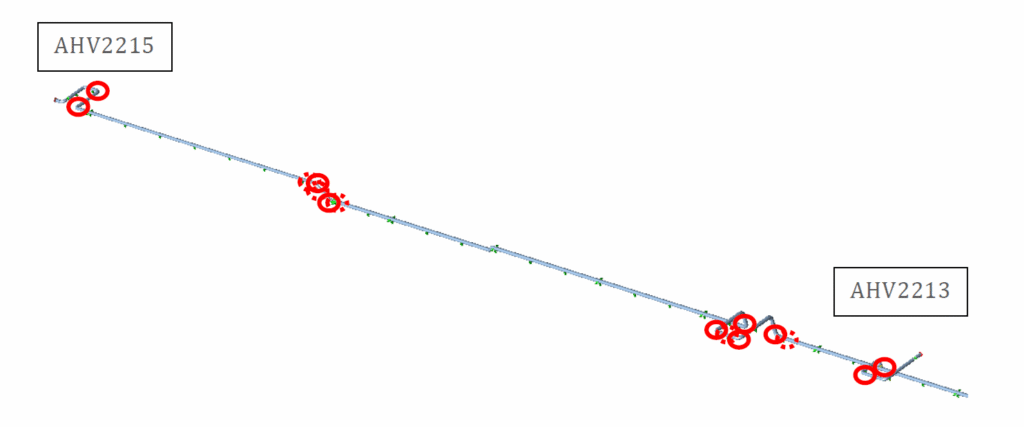
However, in several other areas where high total stresses were recorded, the dynamic contribution was minimal or negligible. This indicated that the dominant issue was static overstress, primarily driven by thermal expansion, internal pressure, and sustained loads rather than transient surge forces.

Static Stress Behavior
Although static analysis was not the principal scope, its inclusion was necessary to contextualize dynamic effects. The static assessment demonstrated that most load cases exceeded the code allowable stresses. Only the case representing normal operating conditions (L4) remained within limits.
For the sustained load case (L5: weight + pressure), internal pressure alone generated stresses up to 78 % of the allowable. The addition of weight loads raised stresses to 95–100 %, and inclusion of pressure-induced elongation pushed local stress levels beyond 100 %, particularly near elbows.
In the thermal expansion case (L2: weight + pressure + temperature), stresses increased even further. Pressure and weight contributed approximately 70–85 % of the allowable, while thermal expansion drove several regions above the operational limit. High stresses were concentrated around monitor tee connections, elbows, and expansion loops, confirming that expansion restraint was a key driver of overstress.
Overall, the static results established that the system was already overstressed before dynamic effects were applied, making mitigation through support adjustment alone inefficient.
Dynamic Response and Support Loads
Although static analysis was not the principal scope, its inclusion was necessary to contextualize dynamic effects. The static assessment demonstrated that most load cases exceeded the code allowable stresses. Only the case representing normal operating conditions (L4) remained within limits.
For the sustained load case (L5: weight + pressure), internal pressure alone generated stresses up to 78 % of the allowable. The addition of weight loads raised stresses to 95–100 %, and inclusion of pressure-induced elongation pushed local stress levels beyond 100 %, particularly near elbows.
In the thermal expansion case (L2: weight + pressure + temperature), stresses increased even further. Pressure and weight contributed approximately 70–85 % of the allowable, while thermal expansion drove several regions above the operational limit. High stresses were concentrated around monitor tee connections, elbows, and expansion loops, confirming that expansion restraint was a key driver of overstress.
Overall, the static results established that the system was already overstressed before dynamic effects were applied, making mitigation through support adjustment alone inefficient.

Interpretation of Findings
The combined assessment indicated that dynamic stresses contributed significantly (up to 67 %) at some local points, but the global structural integrity was largely controlled by static load conditions. The overstress pattern suggested that system rigidity and high design parameters (pressure and temperature) were the main contributors. Since the foam system is filled intermittently and does not operate continuously at elevated temperatures, the applied design conditions may be conservative relative to actual operation.
Furthermore, due to the high static stresses, attempts to optimize support placement or stiffness would not yield meaningful reductions in total stress. Therefore, remedial strategies would need to address the fundamental mechanical configuration and loading assumptions.
Recommendations
Based on the dynamic stress analysis, Dynaflow Research Group proposed several mitigation measures aimed at lowering both static and dynamic stress levels and improving system resilience:
- Increase pipe wall thickness at critical locations.
Thicker sections would not only reduce local stress but also enhance stiffness, thereby decreasing deflection and susceptibility to dynamic amplification. - Re-evaluate expansion loops in terms of geometry, size, and position.
Optimizing expansion loop configuration can increase system flexibility and reduce thermal expansion stresses, especially near tees and elbows. - Reconsider design pressure and temperature.
The current design basis of 14 barg and 65 °C may exceed realistic operating conditions. Reducing these parameters could proportionally decrease static stress and mitigate overstress without major structural modifications. - Review allowable stress criteria.
The allowables supplied by the vendor may be conservative or based on material qualification data not representative of the installed product. Confirming these values against actual FRP performance can clarify safety margins.
Finally, irrespective of stress magnitudes, the supporting structures should be verified to ensure they can sustain the maximum loads and displacements observed in the analysis. Compliance checks against Section 3.2 and Appendix E load data were recommended before re-commissioning.
Conclusion
The dynamic stress analysis of the BP Geel foam line AFW-023024 demonstrated that while surge-induced transient loads contribute locally to increased stresses, the principal issue is excessive static loading under current design conditions. Combined stress ratios reached up to 161 %, exceeding ISO 14692 allowable limits in several fittings and straight sections. Peak restraint loads of 21.7 kN and dynamic displacements up to 124 mm were observed.
The findings highlight that the system’s overstress condition is mainly driven by pressure, temperature, and weight effects, with surge forces acting as secondary contributors. Effective mitigation therefore requires a holistic redesign, combining localized reinforcement with global flexibility improvements and potentially revised design criteria.
Through this analysis, Dynaflow Research Group provided BP Chembel with a comprehensive understanding of the foam system’s structural behavior under realistic surge and operating conditions, enabling data-driven decisions for safe operation and design optimization.