
Dynaflow Research Group
Dynaflow webinars online
Dynaflow Research Group regularly hosts technical webinars. These webinars, which are FREE to watch, are recorded and made available online through our YouTube channel. A

Dynaflow Research Group regularly hosts technical webinars. These webinars, which are FREE to watch, are recorded and made available online through our YouTube channel. A

Starting February 11th 2020, our Software Director Erik Jan Lingen together with Matthias Möller from the Faculty of Mathematics will present a course (WI4265TU) on

Upcoming week February 11-13, Dynaflow hosts its latest Fiberglass Engineering training course. During this course participants receive a good understanding of the GRP specific mechanical

Dynaflow Research Group (DRG) has recently been accredited with the quality management standard NEN-EN-ISO 9001:2015. Today, Niels Bos from Dynaflow Research Group received the official ISO9001 certificate from Vincent

There has been a demand for Online FEPipe and NozzlePRO training courses for many years. We are happy to announce that next month we will
For the last couple of months DRG is expanding its training activities online in association with the e-learning platform EngineeringTrainer.com. Our newest online course regards

Besides classroom courses taught at our offices in The Netherlands, The Middle-East or at client premises, we are expanding our training portfolio with online courses.

DRG hosting the ISO/TC 138/SC 6 and WG’s meetings Zoetermeer, 17, 18 and 19 September DRG is hosting the 3-day ISO/TC 138/SC 6 and WG’s
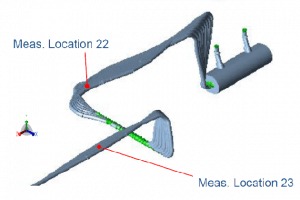
Tuning a beam type FEA model to vibration measurements from the piping of a reciprocating compressor plant Vibrations had been seen in the piping of

DRG presents at the Dutch OpenFOAM User’s Group 2018 DRG is actively involved in the research and application for Computational Fluid Dynamics (CFD) and Discrete

API 674 Acoustical study, some differences between design approach 1 (DA1) and design approach 2 (DA2) When purchasing or delivering a reciprocating pump an API674

Recently in the fall of 2017 a renewed edition of the ISO14692, the governing standard for fiber reinforced plastic piping, was officially released. The objective

B31J: The answer to Markl’s 1950’s flexibilty factors The new 2017 ASME B31J Up to recent years most pipe flexibility analyses and more specifically Caesar

DFC2017 keynote: Simulation requirements for oil and gas transport in pipeline systems Presentation by Prof. dr. ir. Ruud A.W.M. Henkes (Shell Projects and Technology/Delft University
DFC2017 abstracts: Efficient Industrial Conjugate Heat Transfer in HELYX v3 Presentation by Dr. Eugene de Villiers PhD. MSc. DIC (Engys UK) DRG is proud to

DRG at the Multiphase Production Technology 2017 Conference Cannes 7-8-9 June 2017 in Cannes, France In the first week of June 2017, DRG attended the

Analysis of Surge problems with CAESAR II and BOSfluids 5.4 The webinar Together with Hexagon PPM, DRG is co-hosting a free webinar on Analysis of

DRG’s Richard Fawcett looks at the importance of designing for pressure surges in an LNG bunkering line. February 2017 In the February issue of LNG

Meeting the challenges of Oil & Gas The Oil & Gas and petrochemical field can be prone to difficulties when it comes to efficiency, flow

Bridging the gap between research and field work Dynaflow Research Group will be presenting two papers at the 3rd International Rotating Equipment Conference on September
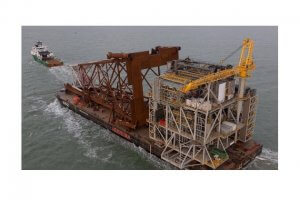
Alba B3 platform installed – DRG performed surge analysis It is always nice to see your computer models becoming reality! DRG performed a surge analysis

Table of Contents A Good GRP Code Covers a Large Variety of Products and Loading Conditions A robust Glass Reinforced Plastic (GRP) piping code must
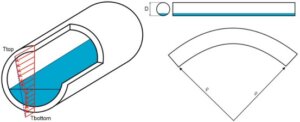
Thermal bowing is a structural phenomenon that arises when a temperature gradient exists across the cross-section of a pipe or vessel. In typical pipe design,

Table of Contents As the demand for flexible, energy-efficient, and reliable compressor operation grows—particularly in hydrogen and process gas applications—our clients increasingly turn to stepless

Table of Contents Multiphase flow is a recurring challenge in process engineering, where multiple fluid phases—such as gases, liquids, or solids—interact within a single flow

In the chemical and energy industries, liquid products such as LNG, ammonia, or naphtha are commonly transferred between ships and onshore storage tanks. These transfers
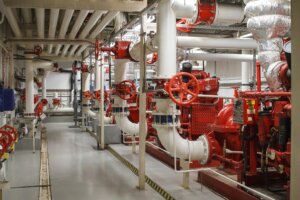
In the engineering domain, accurately simulating transient events in pipeline systems is critical, particularly for essential safety mechanisms such as firewater systems. These systems, typically

Introduction Pressure vessels are critical components in a wide range of industries, including power generation, petrochemical processing, and industrial manufacturing. These vessels are designed to
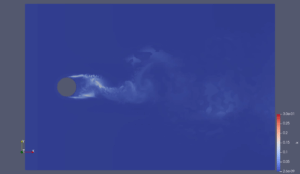
When Theodor von Kármán first discovered vortex shedding in 1911, he likely had no idea how pivotal his work would become for modern engineering, particularly
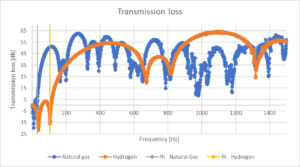
In a previous article, we introduced the risks and design considerations of repurposing an existing natural gas compressor system for hydrogen. That discussion focused on

ON-DEMAND 🕖 30 MIN 🌏︎ ENGLISH Understanding and Mitigating AIV and FIV in Modern Plant Design David Tickner Senior Engineer Get instant access
ON-DEMAND 🕖 30 MIN 🌏︎ ENGLISH How To Predict Stresses From Slug Flows Daniëlle de Jong Senior Engineer Get instant access Free recording
ON-DEMAND 🕖 60 MIN 🌏︎ ENGLISH Building models using the import PCF file feature & model verification In BOSfluids Thijs Krijger Project Engineer

ON-DEMAND 🕖 60 MIN 🌏︎ ENGLISH Solving Vibrations In A Two-Phase Process Line Frank Bos Partner Get instant access Free. Recording + slide

ON-DEMAND 🕖 50 MIN 🌏︎ ENGLISH Surge and dynamic stress analysis for an offshore wind farm using BOSfluids Mark Groen Software Lead Engineer

ON-DEMAND 🕖 25 MIN 🌏︎ ESPAÑOL Integración de BOSfluids con Caesar II y otros programas de tensión de tuberías Uri Peker Engineer Get instant
ON-DEMAND 🕖 35 MIN 🌏︎ ENGLISH BOSfluids integration with CAESAR II and other pipe stress programs Ryan Metcalf Manager USA Get instant access
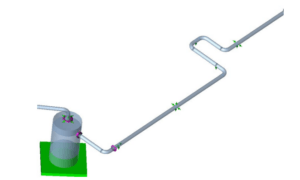
An Offshore Flare System Facing Wind, Thermal and Nozzle Load Constraints An offshore compressor station required a flexibility assessment of the piping running toward and from its flare seal drum (V-004). The work continued an earlier analysis of the same station’s flare system and covered the modified and continuation piping
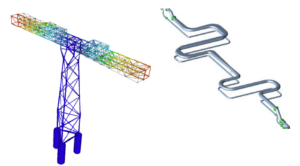
Gas Piping Between Independently Supported Offshore Structures This project assessed the piping that carries gas between an oil production platform and a jack-up platform. The platforms are approximately 100 m apart, and the interconnecting piping, a 42-inch low-pressure line and a 20-inch high-pressure line, is supported from a slender bridge
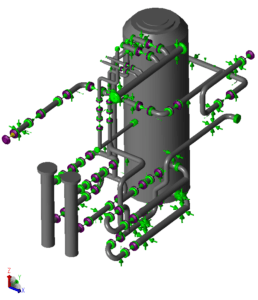
Pipe Stress, Flange and Vessel Nozzle Load Assessment of 6-Inch and Smaller Piping A Floating Production, Storage and Offloading (FPSO) platform that will operate off the west coast of India carries two process systems built from 6-inch and smaller piping: a condensate dewatering system and a fuel gas system. A
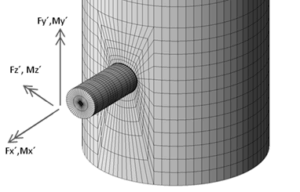
A 42-Inch Inlet Header for Five Offshore Compressor Stations An offshore compressor plant was designed with five very similar compressor stations, all connected by one 42-inch inlet header. Gas arriving from the bridge is first directed through the main inlet separator, and the header then carries it to the individual
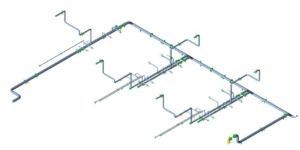
Offshore Flare System Loads and Flange Overstress An offshore compressor station system consists of five very similar compressor stations connected by one 42 inch header. The work covered the flare system of these compressor stations. The location requires wind loads with wind speeds of 240 km/h to be included, with
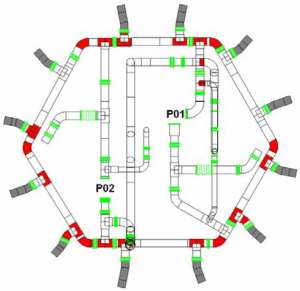
The ballast water system of an FPSO under construction was reassessed for pipe stress after the client commented on the assumptions in an earlier assessment. The system consists of two ballast pumps and twelve ballast tanks. Seawater is drawn from two sea inlet chests through two filters to the pump
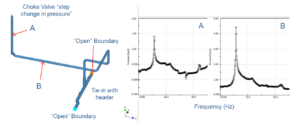
Spring-Supported Tie-In, 114 mm Wellhead Movement A new tie-in connects a wellhead to an 8″ header on a North Sea platform through a 6″ line. Elsewhere on the platform the piping is designated medium stiff, for which the operator’s specification permits simplified screening based on flow velocities. The tie-in line
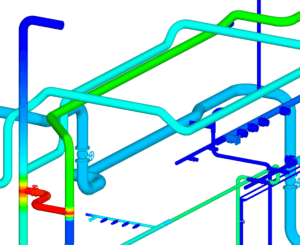
Firewater System Upgrade on Two Bridge-Connected Offshore Platforms As part of an offshore field development, the firewater networks on two bridge-connected platforms, referred to here as Platform A and Platform B, were upgraded. New glass-reinforced epoxy (GRE) piping was installed on both platforms and on the connecting bridge, with short
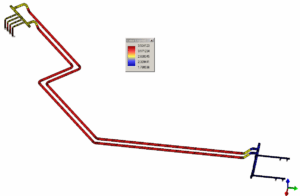
Vacuum Risk in a Buried 1200 mm GRE Seawater Supply The seawater system supplies two vaporisers from a pump manifold through two buried glass-reinforced epoxy (GRE) lines of 1200 mm diameter. Three pumps are connected to the manifold, one of them on standby, each with a capacity of 5,500 m³/h.
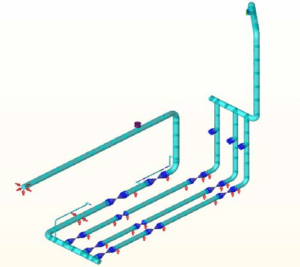
Why Single-Line Metering Raises Gas Velocity and ρV² in the 10-Inch Pipe The natural gas flow metering station on a platform had three parallel metering lines, two active and one spare. The operator decided to replace the orifice-type flow meter in the most eastern line with an ultrasonic flow meter.
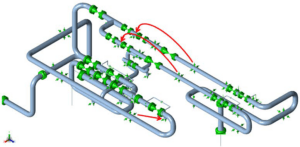
Inter-Stage Overpressure and Surge Loads in Three Valve Upset Scenarios The inter-compressor lines on a gas compression station carry gas between compression stages and cross a bridge between two platforms. A preceding process study addressed concerns in the pressure regulation system: whether the inter-stage pressure could be kept below the
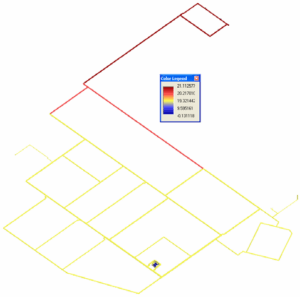
GRE Firewater Network and Pump Start Sequence A grassroots methanol plant distributes firewater through a fibreglass (GRE) ring main serving all units and the common facilities. Aboveground piping at the flare stack area and fire training ground was assumed to be steel. The firewater pumps draw from a firewater pond
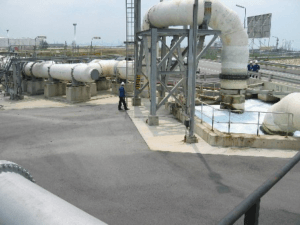
Shared Seawater Intake for an LNG Terminal and a CCGT Plant The IONIO project comprises a new LNG regasification terminal in an industrial area that also hosts the ERG power station, a combined-cycle gas turbine (CCGT) plant. Both facilities need seawater. The terminal uses it to vaporise LNG, while the
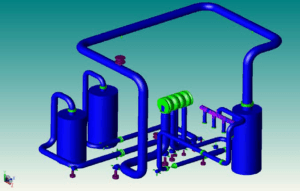
Wind, Barge Motion and API 617 Limits on Large-Bore Compressor Piping On a floating LNG (FLNG) platform, natural gas is compressed in a module installed near the centre of the barge. Four large-bore lines connect to that compressor: a 52-inch low-pressure suction line, a 36-inch medium-pressure suction line, a 30-inch
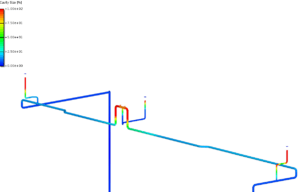
Firewater ring main and surge analysis scope A firewater system was specified for a new platform, to be connected to the firewater systems of the two existing platforms it extends. The system is a wet ring main: permanently water filled and held under pressure by a jockey pump on one
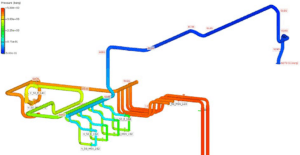
Water hammer on a sister platform and the GRE seawater system The seawater system on a 690 MW offshore converter station provides seawater for cooling. During testing of the seawater system on a sister platform, water hammer effects were observed during an emergency shutdown of the seawater lift pumps, and
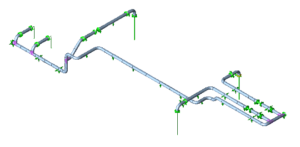
Pipework Displacement During a Seawater Lift Pump ESD During commissioning of the seawater cooling system at an offshore HVDC substation, an emergency shutdown (ESD) of the seawater lift pump produced uncontrolled displacement of the connected 12-inch glass-reinforced epoxy (GRE) pipework. Video of the test showed an estimated 18 mm of
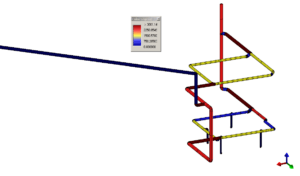
Deluge Piping Configurations and Upset Scenarios Deluge fire water systems had been installed on three offshore monopiles. A surge (waterhammer) analysis was carried out for two purposes. The first was to determine the maximum pressure in each system and the unbalanced forces to be accommodated by the support system. The
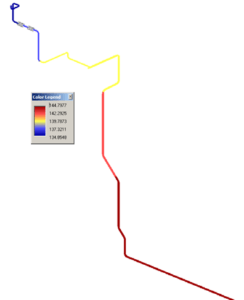
Slug Impact on a Closing HIPPS Valve A 16-inch steel gas riser lands on a platform, and a 12-inch line branches off the riser into the platform. A HIPPS valve on the 12-inch branch protects the downstream platform from pressures exceeding 150 Barg. The 16-inch riser is exposed to slug
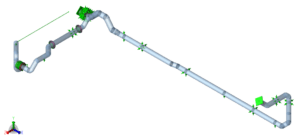
GRE Header Design Conditions and Material Properties An above-ground seawater header in glass-fibre reinforced epoxy (GRE) supplies seawater to a process unit through two tie-ins on a seawater pump discharge manifold. The analysis assessed the static stresses in the header and defined a support arrangement that supports and stabilises the
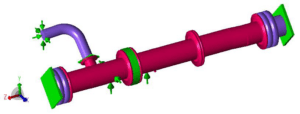
Bellow Overextension in a DN800 GRE Seawater Spool A DN800 spool in glass-fibre reinforced epoxy (GRE) was to be installed to transport seawater. The GRE material has unequal axial and hoop stiffness, with an axial elastic modulus of 10,500 MPa and a hoop elastic modulus of 20,500 MPa. Its “effective”

DYNAFLOW RESEARCH GROUP (“DRG”) Enters into Reseller Agreement with Quality Professional Software (“QPS”) RIJSWIJK, The Netherlands – January 24, 2024 (Dynaflow Research Group BV) –

Dynaflow Research Group and Seawind Ocean Technology announce collaboration focusing on technical readiness of floating offshore wind applications in the Mediterranean Sea. This landmark partnership