
Software
Annual User day
On July 5th Dynaflow will organize a Software User Day. During this event participants will learn about new and upcoming features, discuss existing features and meet other

On July 5th Dynaflow will organize a Software User Day. During this event participants will learn about new and upcoming features, discuss existing features and meet other

Recently Dynaflow Research Group together with online training platform EngineeringTrainer.com released “How to Review a Pulsation Study” training course. The course objective is to explain

In April of this year Dynaflow Research Group will present two papers at the International Conference on Pressure Surges.

Dynaflow Research Group will give a technical presentation during the SPE Symposium: Non-Metallics in Abu Dhabi February 2023.

We are pleased to announce that Frank Bos has been elected partner at Dynaflow Research Group.

From March 20th until March 24th, Dynaflow Research Group will collaborate with the Numerical Analysis group of the Department of Applied Mathematics at Delft University

We are glad to announce that the BOSfluids course has been updated. The course has been restructured and expanded to provide insights on the latest version of the BOSfluids program.
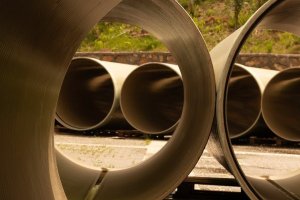
The basis for reliable fiberglass piping systems are the specifications that lay out the requirements to the system regarding material quality, engineering, installation and inspection and test plans.

Cooling water installations are designed to cool an installation in the event of a nearby fire. This can be necessary if the contents of a tank or pressure vessel are likely to expand with heat. We can use BOSfluids to perform hydraulic calculations of steady state flows in a cooling water system that includes many deluge nozzles (sprinklers).

The latest BOSfluids release brings a new, low-cost license option that is aimed at users who are primarily interested in performing steady state analyses.

Dynaflow Research Group has recently performed several level 1 and 3 assessments resulting in either extended service lifetimes or recommendation of component replacement.

The new BOSfluids release brings many small and large improvements to its user interface that make it even more efficient and versatile.
Dynaflow proudly presents a new online training course: “Pipe Stress Analysis”.
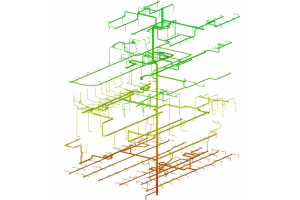
Dynaflow Research Group has performed the design and analysis for the firewater deluge layout of two large production modules of a floating production storage and
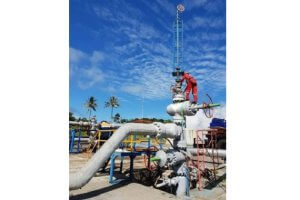
Two of the key challenges currently encountered in operating geothermal wells using conventional steel casings are corrosion and scaling. These problems significantly reduce the lifespan

Today Dynaflow Research Group will join the TU Delft Institute for Computational Science and Engineering (DCSE) in hosting an introductory course in the use of

When do you need to perform a fatigue analyses according ASME BPVC? This webinar explains the screening methods that are provided in ASME-VIII – Div 2.
Coming weeks Dynaflow Research Group will host a webinar series around the use of the stress envelope for FRP stress analysis. In this webinar series

Seawind have developed with early partners Offshore Wind Plant layouts and is applying for sea area concessions in the Mediterranean Sea sector. The Mediterranean Sea
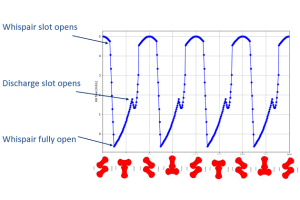
Dynaflow performed an pulsation analysis study for a client where a silencer check was required to dampen the pulsations generated by a rotary lobe blower.

Piping models that you produce are not 100% accurate. To make sure that uncertainties in design do not immediately result in failures in your piping

Table of Contents A Good GRP Code Covers a Large Variety of Products and Loading Conditions A robust Glass Reinforced Plastic (GRP) piping code must
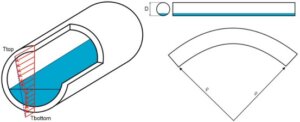
Thermal bowing is a structural phenomenon that arises when a temperature gradient exists across the cross-section of a pipe or vessel. In typical pipe design,

Table of Contents As the demand for flexible, energy-efficient, and reliable compressor operation grows—particularly in hydrogen and process gas applications—our clients increasingly turn to stepless

Table of Contents Multiphase flow is a recurring challenge in process engineering, where multiple fluid phases—such as gases, liquids, or solids—interact within a single flow

In the chemical and energy industries, liquid products such as LNG, ammonia, or naphtha are commonly transferred between ships and onshore storage tanks. These transfers
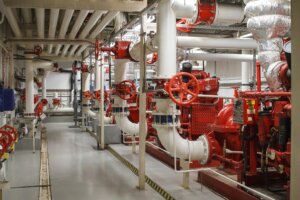
In the engineering domain, accurately simulating transient events in pipeline systems is critical, particularly for essential safety mechanisms such as firewater systems. These systems, typically

Introduction Pressure vessels are critical components in a wide range of industries, including power generation, petrochemical processing, and industrial manufacturing. These vessels are designed to
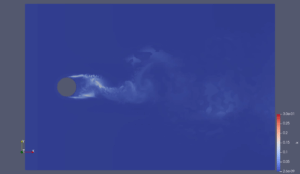
When Theodor von Kármán first discovered vortex shedding in 1911, he likely had no idea how pivotal his work would become for modern engineering, particularly
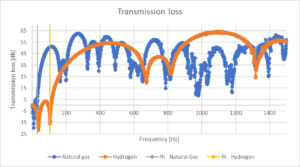
In a previous article, we introduced the risks and design considerations of repurposing an existing natural gas compressor system for hydrogen. That discussion focused on

ON-DEMAND 🕖 30 MIN 🌏︎ ENGLISH Understanding and Mitigating AIV and FIV in Modern Plant Design David Tickner Senior Engineer Get instant access
ON-DEMAND 🕖 30 MIN 🌏︎ ENGLISH How To Predict Stresses From Slug Flows Daniëlle de Jong Senior Engineer Get instant access Free recording
ON-DEMAND 🕖 60 MIN 🌏︎ ENGLISH Building models using the import PCF file feature & model verification In BOSfluids Thijs Krijger Project Engineer

ON-DEMAND 🕖 60 MIN 🌏︎ ENGLISH Solving Vibrations In A Two-Phase Process Line Frank Bos Partner Get instant access Free. Recording + slide

ON-DEMAND 🕖 50 MIN 🌏︎ ENGLISH Surge and dynamic stress analysis for an offshore wind farm using BOSfluids Mark Groen Software Lead Engineer

ON-DEMAND 🕖 25 MIN 🌏︎ ESPAÑOL Integración de BOSfluids con Caesar II y otros programas de tensión de tuberías Uri Peker Engineer Get instant
ON-DEMAND 🕖 35 MIN 🌏︎ ENGLISH BOSfluids integration with CAESAR II and other pipe stress programs Ryan Metcalf Manager USA Get instant access
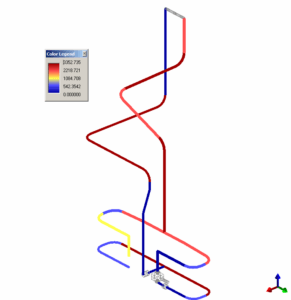
Weld 34 Crack and Dead-End Configuration The circulation system has two pumps, one operating and one spare. The operating pump feeds cooling water back into the Benson vessel at the top of the system. In the situation analysed, one pump had been taken out for revision. A blind valve was
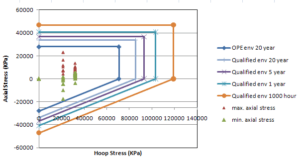
Branch Failures in a Buried GRP Firewater Ring The firewater system is made from glass-reinforced plastic (GRP) pipe and is mainly underground. The main is a ring with large-bore branch connections, and smaller-bore branch connections feed the hydrants and monitors above ground. In early operation the system suffered a number
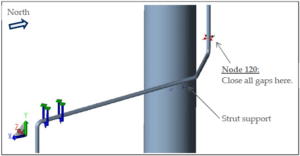
Slug Flow Operation and Two Elbow Fatigue Failures At a gas-to-liquids facility, the water feed line to an HCN/NH3 stripper (1C-1201) regularly operated in the slug flow regime. Slugs can generate large dynamic loads on the piping, which can eventually result in fatigue failures. Two leakage incidents occurred, each caused
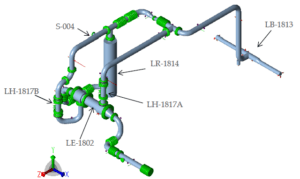
Flange Leakage in 44-Inch Catalytic Oxidiser Piping The 44-inch top and bottom nozzles of a catalytic oxidiser are connected to the shell and tube sides of a recuperative heater by 44-inch piping. The hot design temperature is 527 °C. The required piping flexibility is provided by a number of expansion
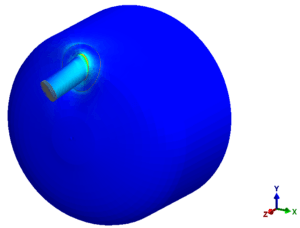
Steam-Out Cycles of the Carbon Bed Vessels In the offgas cleaning system of an EBHP reaction section, vessels V105A to V105D absorb EB from the offgas on active carbon beds, because the EB has to be removed before flaring for environmental reasons. Once a bed is saturated, it is steamed
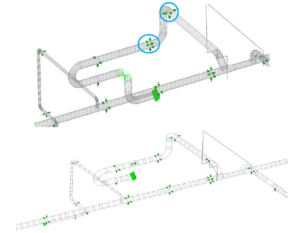
A Branch Failure on a Methanol Plant Steam Header A methanol plant operating on a 3,000 tonnes per day basis suffered a piping failure on 19 May 2012. A ¾ inch branch broke off the medium-pressure (MP) steam header when the turbine driving the synthesis gas compressor tripped. In normal
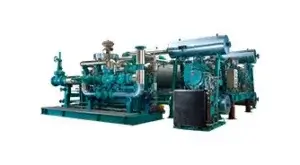
A pulsation analysis to API 618 Design Approach 1 checked the proposed dampener bottles of onshore and offshore reciprocating compressors against a guideline of 70 percent of the allowable pulsation levels. All proposed bottles gave levels within the API 618 allowable. At the line connection nozzle, only the offshore discharge
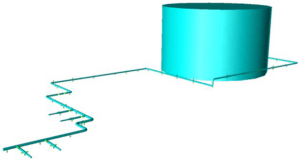
Condensate Forwarding Duty at a Nigerian Gas Plant At a gas plant in Nigeria, four reciprocating pumps on an N+1 philosophy (three running, one spare) forward condensate from a storage and separation tank into a gas pipeline. A 12-inch suction header carries the condensate from the tank to the pumps,
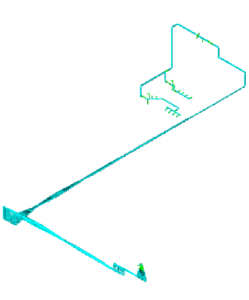
Severe Vibration in Vaporiser Feed Pump Piping The suction and discharge piping connected to the quadruplex methanol vaporiser feed pumps was suffering from severe vibration. A pulsation analysis combined with a mechanical response analysis of the as-built piping was performed to establish the root cause. The analyses determined the stress
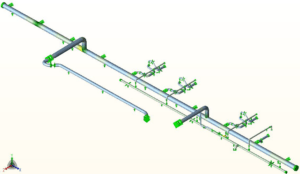
At the Utorogu Flow Station in Nigeria, vibration was observed in the suction header, the discharge header and the pump recirculation line. Dynaflow Research Group performed pulsation, mechanical response and static stress analyses to find the root cause, identify any other possible problems and recommend improvements. The station pumps crude
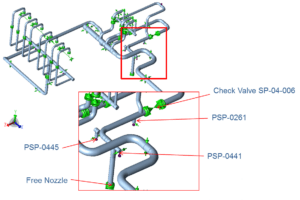
A third-party review of the HP discharge line at a gas compression station found that the designer’s stress report shows the discharge nozzle conforming to the vendor’s allowable values with the springs pinned, as API 686 requires. At the 7th April alignment check the flange separation exceeded the 4.5mm vendor
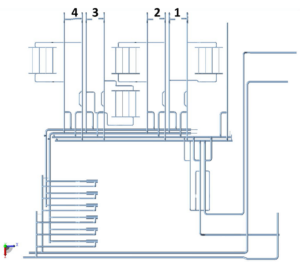
A new natural gas booster plant at Winksele, Belgium, was undergoing Site Approval Tests (SAT) after the end of construction. The SAT scope included a pipe vibration level assessment to verify that all vibration levels were within acceptable limits. This case study describes the measurement campaign and the VDI 3842
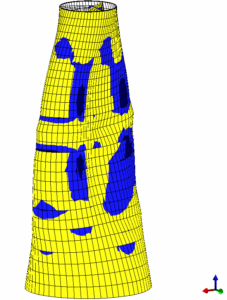
Compressor Suction Strainer and Its Fatigue Cracking The suction strainer of a centrifugal compressor developed fatigue cracks. The strainer is a perforated stainless steel truncated cone (Werkstoff 1.4571), 970 mm long, with an outside diameter of 160 mm at the upstream end and 420 mm at the downstream end. The
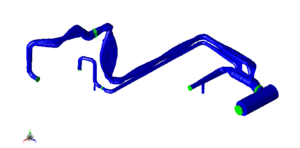
Operating Context and Damper Configuration Assumed At a plant in Qatar, a Dresser Roots compressor compresses seal gas in two stages. The client requested a simulation study, both acoustic and mechanical, of the compressor piping between the first-stage discharge and the second-stage suction. The second-stage bypass lines are included. The
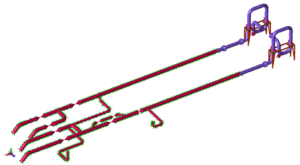
Why Pulsation Risks Warranted Attention Before Operation The compression station was designed to increase and maintain operating pressure on a natural gas piping network, overcoming friction losses. It has four (3+1) two-stage centrifugal compressors with 19-blade impellers, running at a rated speed of 5750 RPM (95.8 Hz) within a range
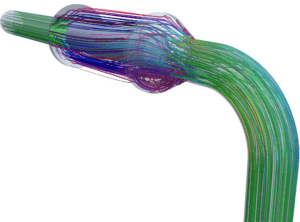
A Commissioning Failure That Sent Debris Downstream During commissioning of a natural gas compressor station, pieces of fibreglass fabric, mineral wool and steel wire were found throughout the downstream system. A small amount of mineral wool was also found in the surge valve. Inspection showed that the mineral wool found
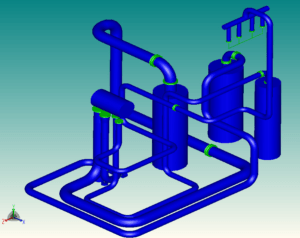
Compressor Piping Under Combined Marine and Process Loading The compressor module was located roughly halfway along the hull. Its connected piping had to accommodate thermal and pressure loads, wind loads, accelerations from wave-driven barge rocking and relative displacements from hull deformation. These loads could produce pipe deflection and bending and
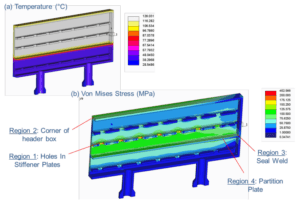
Cyclic Thermal Duty in a Gas Treatment Air Cooler An air-cooled heat exchanger for a gas treatment plant is subjected to a varying inlet temperature. In the analysed winter case, which has the largest temperature variation, the fluid cycles between 7.5°C and 288°C during each 100-minute cycle. The first part
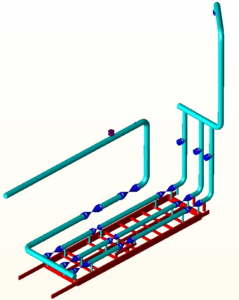
Consolidating Gas Flow onto a Single Metered Line A platform gas metering station has three parallel metering lines, two active and one spare. The modification replaces the orifice-type flow meter in the most eastern line with an ultrasonic (US) flow meter and directs the complete gas flow through that line.
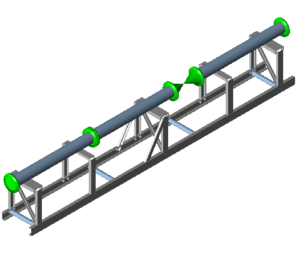
Nitrogen Skid Stress Verification Requirement A manufacturer produces a nitrogen metering skid for a project. As a result of a client performance requirement, the existing design had to be verified by stress analysis. The skid is a straight pipe configuration with valves and flow meters, supported approximately 1000 mm above
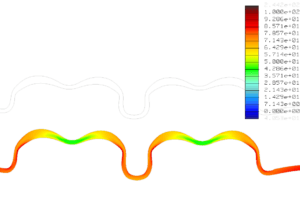
An axisymmetric finite element analysis checked the flued flange expansion joint of a fixed-fixed tubesheet reboiler for low cycle fatigue, high cycle fatigue and primary stress to ASME Section VIII Division 2, at mean (26 mm) and minimum (22 mm) wall thickness. The largest low cycle fatigue stress range was

DYNAFLOW RESEARCH GROUP (“DRG”) Enters into Reseller Agreement with Quality Professional Software (“QPS”) RIJSWIJK, The Netherlands – January 24, 2024 (Dynaflow Research Group BV) –

Dynaflow Research Group and Seawind Ocean Technology announce collaboration focusing on technical readiness of floating offshore wind applications in the Mediterranean Sea. This landmark partnership