Fluid Flow
Heat Exchangers in Concentrating Solar Power
DRG performs structural assessments on Heat Exchangers for Concentrating Solar Power plants The US Office of Energy Efficiency & Renewable Energy proclaimed 2014 ‘The year

DRG performs structural assessments on Heat Exchangers for Concentrating Solar Power plants The US Office of Energy Efficiency & Renewable Energy proclaimed 2014 ‘The year

Flow Assurance training course offers a valuable opportunity to learn from and seek advice from one of the foremost experts in Oil and Gas Flow

Presentations by keynote speaker Prof. Dr. ir. Ruud Henkes (Shell / TU Delft) and Dr. Andrew Jackson (Engys UK) The abstracts for the presentations by

Title: Vacuumatics: 3D Formwork Systems By Franciscus Antonius Augustinus Huijben One of the most important architectural trends of the last two decades is commonly referred

Titel: Computational Modelling of Particle Packing in Concrete By Huan He Physical particle packing is becoming a hot topic in concrete technology as more and

Titel: Porosity of Concrete – Morphological Study of Model Concrete By Jing Hu Porosity of Concrete has developed a comprehensive methodological framework for characterizing geometrical

Titel: Mesostructure of concrete Stereological analysis and some mechanical implications By Jianjun Zheng On the mesoscale, concrete can be considered as a composite material consisting

Benefit of computational simulation of a pulsation dampener compared to an analytical method Accumulators are used to reduce pressure pulsations from reciprocating pumps by adding

ON-DEMAND 🕖 50 MIN 🌏︎ ENGLISH Acoustically Induced Fatigue in Gas Filled Piping Systems Using BOSfluids Remco Boere Senior Software Engineer Get instant access

ON-DEMAND 🕖 60 MIN 🌏︎ ENGLISH Simulation Strategies and Practical Application for Vapour Cavity Formation Dr. Ir. Erik Jan Lingen Software Director Get
ON-DEMAND 🕖 60 MIN 🌏︎ ENGLISH Fundamentals, Failure Mechanisms, and Engineering Consequences of Vapor Cavity Formation Dr. Ir. Erik Jan Lingen Software Director

ON-DEMAND 🕖 45 MIN 🌏︎ ENGLISH Bridging the Gap: From NFPA 15 Steady-State Design to Transient Surge Analysis in Tank Terminals Uri Peker

ON-DEMAND 🕖 45 MIN 🌏︎ ENGLISH Support Stiffness Effects on Mechanical Natural Frequencies in Reciprocating Compressor Piping Systems Thijs Krijger Project Engineer Get

ON-DEMAND 🕖 60 MIN 🌏︎ ENGLISH Beyond hydraulics: a practical guide to fire water analyses with BOSfluids Dr. Ir. Erik Jan Lingen Software
AIV Fundamentals At what pipe diameter and wall thickness should one be concerned about AIV? What is the relevant D/T ratio? This depends on the
ON-DEMAND 🕖 3 SESSIONS x 45 MIN 🌏︎ ENGLISH Complete Pulsation Analysis Using BOSpulse Tim Gebraad Software Lead Engineer Marienne Faro Software Sales Engineer

ON-DEMAND 🕖 60 MIN 🌏︎ ENGLISH Getting the Timing Right: Why Time Step Size Is Critical In Surge Analysis Dr. Ir. Erik Jan
ON-DEMAND 🕖 30 MIN 🌏︎ ENGLISH Protecting Tank Terminal Assets Through Surge and FFS Analyses Thijs Krijger Project Engineer Katrine van Overhagen Engineer

ON-DEMAND 🕖 60 MIN 🌏︎ ENGLISH Choosing the right GRE piping standard: a comparison of ISO 14692 and ASME NM.2 Edwin Schimmel Project Engineer

ON-DEMAND 🕖 50 MIN 🌏︎ ENGLISH How Stepless Capacity Control Shapes Flow and Pulsations Thijs Krijger Project Engineer Get instant access Free. Recording

ON-DEMAND 🕖 60 MIN 🌏︎ ENGLISH Water Hammer Analysis & Mitigation in Pipeline Systems with BOSfluids Dr. Ir. Erik Jan Lingen Software Director

ON-DEMAND 🕖 60 MIN 🌏︎ ENGLISH Water Hammer Analysis & Mitigation in Pipeline Systems with BOSfluids Dr. Ir. Erik Jan Lingen Software Director

ON-DEMAND 🕖 35 MIN 🌏︎ ENGLISH Understanding, Modelling, and Managing Thermal Bowing using CAESAR II David Tickner Senior Engineer Get instant access Free.
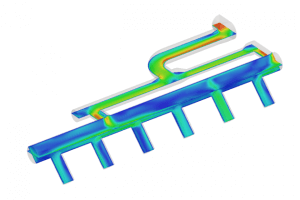
What are the key challenges in applying CFD to simulate and optimize multiphase processes in complex industrial systems? The main challenge here is the ability

Do CAESAR II formulas for thermal bowing and output results match with FEA? Short Answer: There can be significant differences between the results of CAESAR II and FEA.Explanation:The
ON-DEMAND 🕖 35 MIN 🌏︎ ENGLISH Using CFD for optimizing multiphase process engineering Bart van der Zalm Senior Engineer Get instant access Free.

DRG CONFERENCE – 35TH ANNIVERSARY 🌏︎ ENGLISH Innovations that Change the Engineering Industry Get instant access Free. Recording + slide deck available Event Description

ON-DEMAND 🕖 35 MIN 🌏︎ ENGLISH Fatigue Assessment According to ASME B&PV VIII Div.2 Lukas Bajarunas Senior Software Engineer Get instant access Free
ON-DEMAND 🕖 45 MIN 🌏︎ ENGLISH Fiberglass Piping Stress Envelope According to ISO 14692 using CAESAR II Edwin Schimmel Project Engineer Get instant
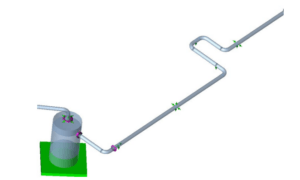
An Offshore Flare System Facing Wind, Thermal and Nozzle Load Constraints An offshore compressor station required a flexibility assessment of the piping running toward and from its flare seal drum (V-004). The work continued an earlier analysis of the same station’s flare system and covered the modified and continuation piping
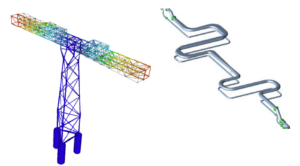
Gas Piping Between Independently Supported Offshore Structures This project assessed the piping that carries gas between an oil production platform and a jack-up platform. The platforms are approximately 100 m apart, and the interconnecting piping, a 42-inch low-pressure line and a 20-inch high-pressure line, is supported from a slender bridge
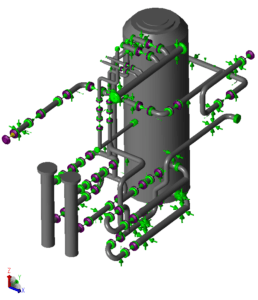
Pipe Stress, Flange and Vessel Nozzle Load Assessment of 6-Inch and Smaller Piping A Floating Production, Storage and Offloading (FPSO) platform that will operate off the west coast of India carries two process systems built from 6-inch and smaller piping: a condensate dewatering system and a fuel gas system. A
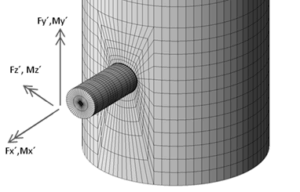
A 42-Inch Inlet Header for Five Offshore Compressor Stations An offshore compressor plant was designed with five very similar compressor stations, all connected by one 42-inch inlet header. Gas arriving from the bridge is first directed through the main inlet separator, and the header then carries it to the individual
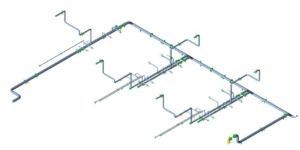
Offshore Flare System Loads and Flange Overstress An offshore compressor station system consists of five very similar compressor stations connected by one 42 inch header. The work covered the flare system of these compressor stations. The location requires wind loads with wind speeds of 240 km/h to be included, with
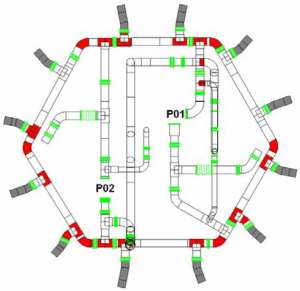
The ballast water system of an FPSO under construction was reassessed for pipe stress after the client commented on the assumptions in an earlier assessment. The system consists of two ballast pumps and twelve ballast tanks. Seawater is drawn from two sea inlet chests through two filters to the pump
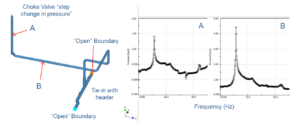
Spring-Supported Tie-In, 114 mm Wellhead Movement A new tie-in connects a wellhead to an 8″ header on a North Sea platform through a 6″ line. Elsewhere on the platform the piping is designated medium stiff, for which the operator’s specification permits simplified screening based on flow velocities. The tie-in line
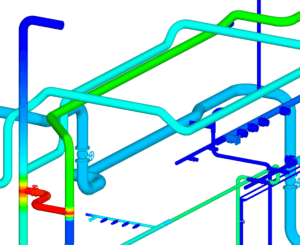
Firewater System Upgrade on Two Bridge-Connected Offshore Platforms As part of an offshore field development, the firewater networks on two bridge-connected platforms, referred to here as Platform A and Platform B, were upgraded. New glass-reinforced epoxy (GRE) piping was installed on both platforms and on the connecting bridge, with short
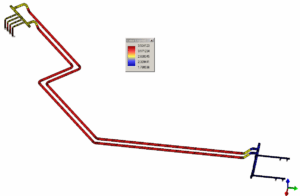
Vacuum Risk in a Buried 1200 mm GRE Seawater Supply The seawater system supplies two vaporisers from a pump manifold through two buried glass-reinforced epoxy (GRE) lines of 1200 mm diameter. Three pumps are connected to the manifold, one of them on standby, each with a capacity of 5,500 m³/h.
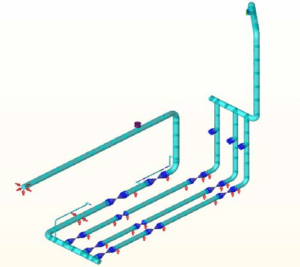
Why Single-Line Metering Raises Gas Velocity and ρV² in the 10-Inch Pipe The natural gas flow metering station on a platform had three parallel metering lines, two active and one spare. The operator decided to replace the orifice-type flow meter in the most eastern line with an ultrasonic flow meter.
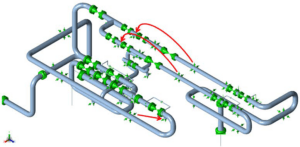
Inter-Stage Overpressure and Surge Loads in Three Valve Upset Scenarios The inter-compressor lines on a gas compression station carry gas between compression stages and cross a bridge between two platforms. A preceding process study addressed concerns in the pressure regulation system: whether the inter-stage pressure could be kept below the
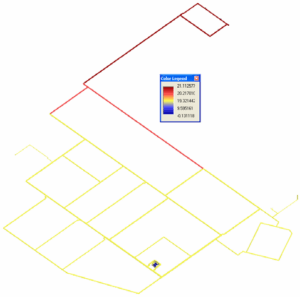
GRE Firewater Network and Pump Start Sequence A grassroots methanol plant distributes firewater through a fibreglass (GRE) ring main serving all units and the common facilities. Aboveground piping at the flare stack area and fire training ground was assumed to be steel. The firewater pumps draw from a firewater pond
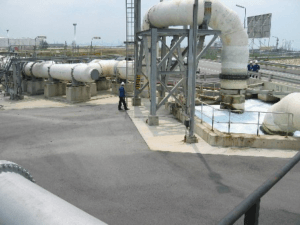
Shared Seawater Intake for an LNG Terminal and a CCGT Plant The IONIO project comprises a new LNG regasification terminal in an industrial area that also hosts the ERG power station, a combined-cycle gas turbine (CCGT) plant. Both facilities need seawater. The terminal uses it to vaporise LNG, while the
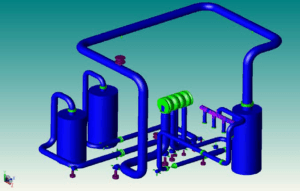
Wind, Barge Motion and API 617 Limits on Large-Bore Compressor Piping On a floating LNG (FLNG) platform, natural gas is compressed in a module installed near the centre of the barge. Four large-bore lines connect to that compressor: a 52-inch low-pressure suction line, a 36-inch medium-pressure suction line, a 30-inch
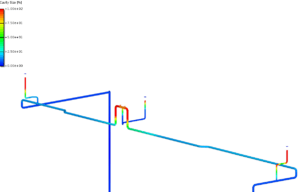
Firewater ring main and surge analysis scope A firewater system was specified for a new platform, to be connected to the firewater systems of the two existing platforms it extends. The system is a wet ring main: permanently water filled and held under pressure by a jockey pump on one
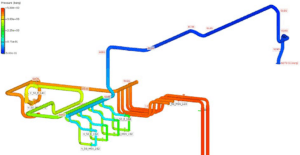
Water hammer on a sister platform and the GRE seawater system The seawater system on a 690 MW offshore converter station provides seawater for cooling. During testing of the seawater system on a sister platform, water hammer effects were observed during an emergency shutdown of the seawater lift pumps, and
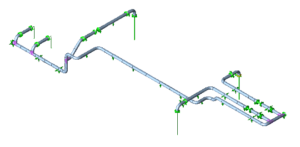
Pipework Displacement During a Seawater Lift Pump ESD During commissioning of the seawater cooling system at an offshore HVDC substation, an emergency shutdown (ESD) of the seawater lift pump produced uncontrolled displacement of the connected 12-inch glass-reinforced epoxy (GRE) pipework. Video of the test showed an estimated 18 mm of
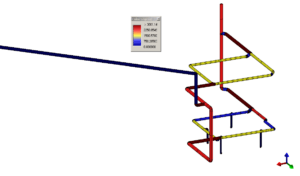
Deluge Piping Configurations and Upset Scenarios Deluge fire water systems had been installed on three offshore monopiles. A surge (waterhammer) analysis was carried out for two purposes. The first was to determine the maximum pressure in each system and the unbalanced forces to be accommodated by the support system. The
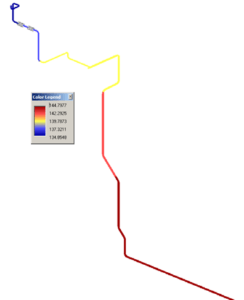
Slug Impact on a Closing HIPPS Valve A 16-inch steel gas riser lands on a platform, and a 12-inch line branches off the riser into the platform. A HIPPS valve on the 12-inch branch protects the downstream platform from pressures exceeding 150 Barg. The 16-inch riser is exposed to slug
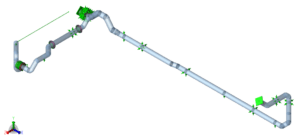
GRE Header Design Conditions and Material Properties An above-ground seawater header in glass-fibre reinforced epoxy (GRE) supplies seawater to a process unit through two tie-ins on a seawater pump discharge manifold. The analysis assessed the static stresses in the header and defined a support arrangement that supports and stabilises the
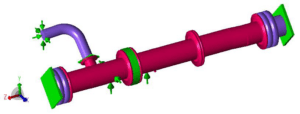
Bellow Overextension in a DN800 GRE Seawater Spool A DN800 spool in glass-fibre reinforced epoxy (GRE) was to be installed to transport seawater. The GRE material has unequal axial and hoop stiffness, with an axial elastic modulus of 10,500 MPa and a hoop elastic modulus of 20,500 MPa. Its “effective”

DYNAFLOW RESEARCH GROUP (“DRG”) Enters into Reseller Agreement with Quality Professional Software (“QPS”) RIJSWIJK, The Netherlands – January 24, 2024 (Dynaflow Research Group BV) –

Dynaflow Research Group and Seawind Ocean Technology announce collaboration focusing on technical readiness of floating offshore wind applications in the Mediterranean Sea. This landmark partnership