
Engineering Training
FEPipe Essentials Training Course
Dynaflow Research Group has released a new online course: FEPipe Essentials. The objective of this course is to give FEPipe users a strong understanding of

Dynaflow Research Group has released a new online course: FEPipe Essentials. The objective of this course is to give FEPipe users a strong understanding of

On February 9th, Edwin Schimmel, project engineer at Dynaflow Research Group will join a session of EngineeringTrainerTV: “Fiberglass and Steel Piping: Differences in Engineering”. Together

The J-integral Approach in Elastic-Plastic Fatigue Analysis by Tammo Dukker In a fatigue analysis one would like to investigate the susceptibility of a structural component

Last month Dynaflow co-presented a graduate course: “Practical Introduction to Parallel Programming”. The course was organized by the chair on Multiscale Engineering Fluid Dynamics at

Geothermal wells – European sponsored GRE-GEO project: Development of a corrosion-free fiberglass composite well casing as an alternative for a steel casing. As part of
June 9th Dynaflow will join Hexagon PPM’s Industry Insight with Stressman Engineering. Our lead software engineer Mark Groen will join this event to discuss the

In samenwerking met R-Vent hebben wij afgelopen week de webinar: “Hoe visualiseer ik de verspreiding van aerosolen in mijn gebouw?” gepresenteerd. VentiScan heeft een speciaal

Dynaflow Research Group and Hexagon PPM join forces for a series of webinar sessions. In three webinar live sessions we will elaborate how leveraging BOSfluids

The new version of the PRG Finite Element Analysis (FEA) software suite has been released. PRG 2021 contains FEPipe v15.0, NozzlePRO v15.0 and FEATools v15.0

Screw compressors generate pulsations similar to other displacement machines such as reciprocating pumps and compressors. The pulsation suppression devices for screw compressors are also called
” Samen staan we sterker” is een veelal gebruikte slogan sinds dat de Corona-pandemie onder ons is. VentiScan werd opgericht met de gedachte een bijdrage

This year we launched our new service to support schools and other buildings in The Netherlands to optimise their room ventilation against Corona spreading. By
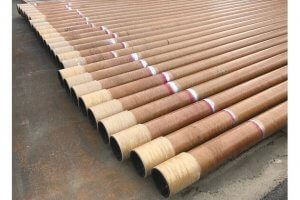
GEOTHERMICA launches Project “Glass Fiber Reinforced Epoxy Casing System for Geothermal Application (GRE GEO)” Some of the main challenges in geothermal are corrosion and scaling.

Many industrial processes involve the transport of granular particles in flowing fluids. Simulation of these granular fluid flows is not trivial because of the different

Press Release Dynaflow Research Group is happy to announce that the European Geothermica project proposal “Glass Fiber Reinforced Epoxy Casing Systems for Geothermal Application” (GRE-GEO)

We are proud to announce the launch of our new service to support schools and other buildings in The Netherlands to optimise their room ventilation

Use DRG cloud licenses: Work more effective from home! During these Covid-19 times many people are working remotely. Software programs which rely on physical devices

Static equipment and piping are designed for a certain design life, often 25 years. During this prolonged use, the material may deteriorate even when the

A detailed Surge analysis leads to a more economic system design compared to a Joukowsky estimate Performing a surge analysis is important to study the

Dynaflow Research Group has a long history in solving advanced flow problems using Computational Fluid Dynamics (CFD) techniques. CFD is applied to a wide range
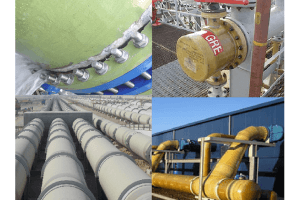
Safety Factors in Fiberglass Engineeringby Mick Bouman (Fiberglass Engineering) For a pipe system or an individual component an engineer must always verify whether the strength

Hydrogen is considered to be a key element in the energy transition. This molecule is the most notable option for the decarbonisation of hard-to-abate sectors
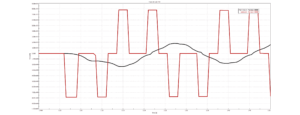
As part of our responsibilities at DRG, we conduct both standard pressure drop calculations and surge/slug analyses for firewater systems. Our involvement spans various stages,
Geothermal energy is a promising renewable energy source, but it comes with its own set of challenges. Two significant issues in geothermal well operations are
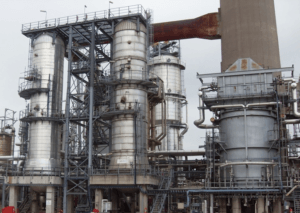
Flow-induced vibrations in piping systems are a critical aspect of mechanical engineering, impacting the reliability and integrity of various industrial setups. The Japan Society of

Introduction In the field of engineering design, the precision of pipe flexibility analysis models is critically important for accurately assessing nozzle loads in steel piping

In 2013, a major incident occurred in a Louisiana chemical plant. In a nonroutine operation, plant operators attempted to start a heat exchanger which had

To understand pressure surges in large piping systems, a good place to start is at home. When you finish washing your hands, turning off the

Brief introduction to piping vibrations Vibrations are an oscillatory motion about an equilibrium. The oscillatory movement causes alternating stresses in the system, which, if excessive

The pulsation challenge of a variable speed reciprocating compressorA pulsation analysis according to the API 618 is a good method of preventing excessive vibrations in

ON-DEMAND 🕖 50 MIN 🌏︎ ENGLISH Acoustically Induced Fatigue in Gas Filled Piping Systems Using BOSfluids Remco Boere Senior Software Engineer Get instant access

ON-DEMAND 🕖 60 MIN 🌏︎ ENGLISH Simulation Strategies and Practical Application for Vapour Cavity Formation Dr. Ir. Erik Jan Lingen Software Director Get
ON-DEMAND 🕖 60 MIN 🌏︎ ENGLISH Fundamentals, Failure Mechanisms, and Engineering Consequences of Vapor Cavity Formation Dr. Ir. Erik Jan Lingen Software Director

ON-DEMAND 🕖 45 MIN 🌏︎ ENGLISH Bridging the Gap: From NFPA 15 Steady-State Design to Transient Surge Analysis in Tank Terminals Uri Peker

ON-DEMAND 🕖 45 MIN 🌏︎ ENGLISH Support Stiffness Effects on Mechanical Natural Frequencies in Reciprocating Compressor Piping Systems Thijs Krijger Project Engineer Get

ON-DEMAND 🕖 60 MIN 🌏︎ ENGLISH Beyond hydraulics: a practical guide to fire water analyses with BOSfluids Dr. Ir. Erik Jan Lingen Software
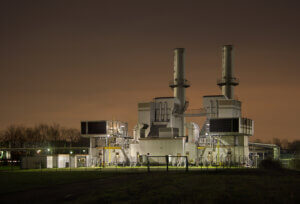
AIV Fundamentals At what pipe diameter and wall thickness should one be concerned about AIV? What is the relevant D/T ratio? This depends on the
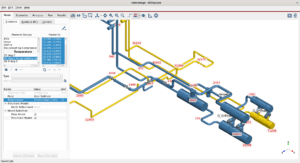
ON-DEMAND 🕖 3 SESSIONS x 45 MIN 🌏︎ ENGLISH Complete Pulsation Analysis Using BOSpulse Tim Gebraad Software Lead Engineer Marienne Faro Software Sales Engineer

ON-DEMAND 🕖 60 MIN 🌏︎ ENGLISH Getting the Timing Right: Why Time Step Size Is Critical In Surge Analysis Dr. Ir. Erik Jan
ON-DEMAND 🕖 30 MIN 🌏︎ ENGLISH Protecting Tank Terminal Assets Through Surge and FFS Analyses Thijs Krijger Project Engineer Katrine van Overhagen Engineer

ON-DEMAND 🕖 60 MIN 🌏︎ ENGLISH Choosing the right GRE piping standard: a comparison of ISO 14692 and ASME NM.2 Edwin Schimmel Project Engineer

ON-DEMAND 🕖 50 MIN 🌏︎ ENGLISH How Stepless Capacity Control Shapes Flow and Pulsations Thijs Krijger Project Engineer Get instant access Free. Recording

ON-DEMAND 🕖 60 MIN 🌏︎ ENGLISH Water Hammer Analysis & Mitigation in Pipeline Systems with BOSfluids Dr. Ir. Erik Jan Lingen Software Director

ON-DEMAND 🕖 60 MIN 🌏︎ ENGLISH Water Hammer Analysis & Mitigation in Pipeline Systems with BOSfluids Dr. Ir. Erik Jan Lingen Software Director

ON-DEMAND 🕖 35 MIN 🌏︎ ENGLISH Understanding, Modelling, and Managing Thermal Bowing using CAESAR II David Tickner Senior Engineer Get instant access Free.
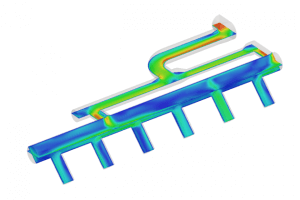
What are the key challenges in applying CFD to simulate and optimize multiphase processes in complex industrial systems? The main challenge here is the ability

Do CAESAR II formulas for thermal bowing and output results match with FEA? Short Answer: There can be significant differences between the results of CAESAR II and FEA.Explanation:The
ON-DEMAND 🕖 35 MIN 🌏︎ ENGLISH Using CFD for optimizing multiphase process engineering Bart van der Zalm Senior Engineer Get instant access Free.

DRG CONFERENCE – 35TH ANNIVERSARY 🌏︎ ENGLISH Innovations that Change the Engineering Industry Get instant access Free. Recording + slide deck available Event Description

ON-DEMAND 🕖 35 MIN 🌏︎ ENGLISH Fatigue Assessment According to ASME B&PV VIII Div.2 Lukas Bajarunas Senior Software Engineer Get instant access Free
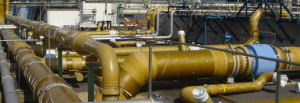
ON-DEMAND 🕖 45 MIN 🌏︎ ENGLISH Fiberglass Piping Stress Envelope According to ISO 14692 using CAESAR II Edwin Schimmel Project Engineer Get instant
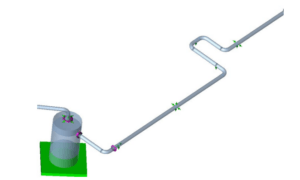
An Offshore Flare System Facing Wind, Thermal and Nozzle Load Constraints An offshore compressor station required a flexibility assessment of the piping running toward and from its flare seal drum (V-004). The work continued an earlier analysis of the same station’s flare system and covered the modified and continuation piping
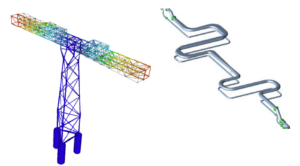
Gas Piping Between Independently Supported Offshore Structures This project assessed the piping that carries gas between an oil production platform and a jack-up platform. The platforms are approximately 100 m apart, and the interconnecting piping, a 42-inch low-pressure line and a 20-inch high-pressure line, is supported from a slender bridge
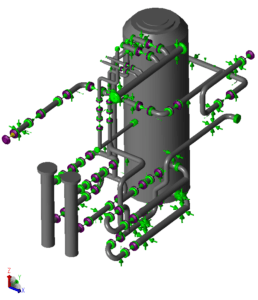
Pipe Stress, Flange and Vessel Nozzle Load Assessment of 6-Inch and Smaller Piping A Floating Production, Storage and Offloading (FPSO) platform that will operate off the west coast of India carries two process systems built from 6-inch and smaller piping: a condensate dewatering system and a fuel gas system. A
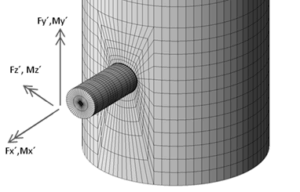
A 42-Inch Inlet Header for Five Offshore Compressor Stations An offshore compressor plant was designed with five very similar compressor stations, all connected by one 42-inch inlet header. Gas arriving from the bridge is first directed through the main inlet separator, and the header then carries it to the individual
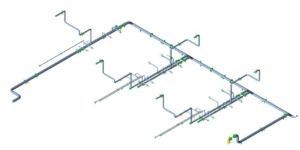
Offshore Flare System Loads and Flange Overstress An offshore compressor station system consists of five very similar compressor stations connected by one 42 inch header. The work covered the flare system of these compressor stations. The location requires wind loads with wind speeds of 240 km/h to be included, with
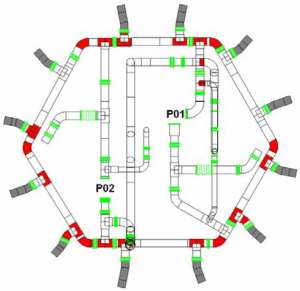
The ballast water system of an FPSO under construction was reassessed for pipe stress after the client commented on the assumptions in an earlier assessment. The system consists of two ballast pumps and twelve ballast tanks. Seawater is drawn from two sea inlet chests through two filters to the pump
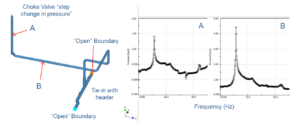
Spring-Supported Tie-In, 114 mm Wellhead Movement A new tie-in connects a wellhead to an 8″ header on a North Sea platform through a 6″ line. Elsewhere on the platform the piping is designated medium stiff, for which the operator’s specification permits simplified screening based on flow velocities. The tie-in line
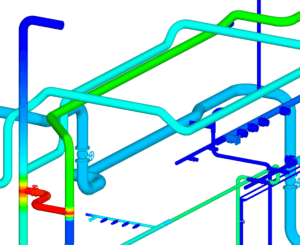
Firewater System Upgrade on Two Bridge-Connected Offshore Platforms As part of an offshore field development, the firewater networks on two bridge-connected platforms, referred to here as Platform A and Platform B, were upgraded. New glass-reinforced epoxy (GRE) piping was installed on both platforms and on the connecting bridge, with short
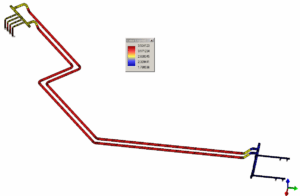
Vacuum Risk in a Buried 1200 mm GRE Seawater Supply The seawater system supplies two vaporisers from a pump manifold through two buried glass-reinforced epoxy (GRE) lines of 1200 mm diameter. Three pumps are connected to the manifold, one of them on standby, each with a capacity of 5,500 m³/h.
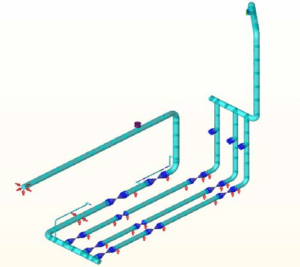
Why Single-Line Metering Raises Gas Velocity and ρV² in the 10-Inch Pipe The natural gas flow metering station on a platform had three parallel metering lines, two active and one spare. The operator decided to replace the orifice-type flow meter in the most eastern line with an ultrasonic flow meter.
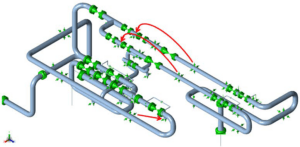
Inter-Stage Overpressure and Surge Loads in Three Valve Upset Scenarios The inter-compressor lines on a gas compression station carry gas between compression stages and cross a bridge between two platforms. A preceding process study addressed concerns in the pressure regulation system: whether the inter-stage pressure could be kept below the
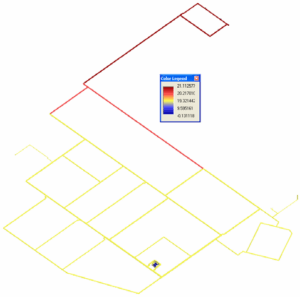
GRE Firewater Network and Pump Start Sequence A grassroots methanol plant distributes firewater through a fibreglass (GRE) ring main serving all units and the common facilities. Aboveground piping at the flare stack area and fire training ground was assumed to be steel. The firewater pumps draw from a firewater pond
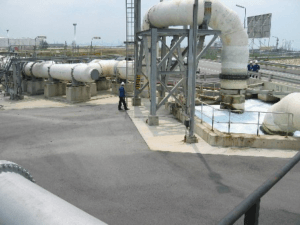
Shared Seawater Intake for an LNG Terminal and a CCGT Plant The IONIO project comprises a new LNG regasification terminal in an industrial area that also hosts the ERG power station, a combined-cycle gas turbine (CCGT) plant. Both facilities need seawater. The terminal uses it to vaporise LNG, while the
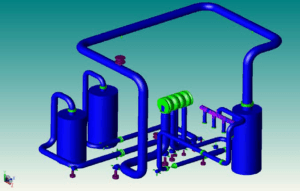
Wind, Barge Motion and API 617 Limits on Large-Bore Compressor Piping On a floating LNG (FLNG) platform, natural gas is compressed in a module installed near the centre of the barge. Four large-bore lines connect to that compressor: a 52-inch low-pressure suction line, a 36-inch medium-pressure suction line, a 30-inch
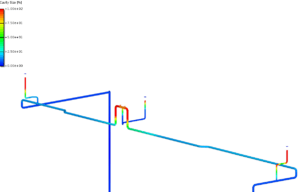
Firewater ring main and surge analysis scope A firewater system was specified for a new platform, to be connected to the firewater systems of the two existing platforms it extends. The system is a wet ring main: permanently water filled and held under pressure by a jockey pump on one
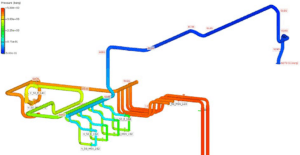
Water hammer on a sister platform and the GRE seawater system The seawater system on a 690 MW offshore converter station provides seawater for cooling. During testing of the seawater system on a sister platform, water hammer effects were observed during an emergency shutdown of the seawater lift pumps, and
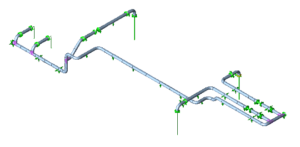
Pipework Displacement During a Seawater Lift Pump ESD During commissioning of the seawater cooling system at an offshore HVDC substation, an emergency shutdown (ESD) of the seawater lift pump produced uncontrolled displacement of the connected 12-inch glass-reinforced epoxy (GRE) pipework. Video of the test showed an estimated 18 mm of
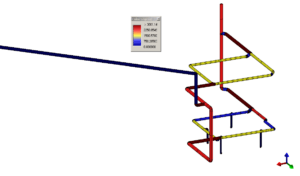
Deluge Piping Configurations and Upset Scenarios Deluge fire water systems had been installed on three offshore monopiles. A surge (waterhammer) analysis was carried out for two purposes. The first was to determine the maximum pressure in each system and the unbalanced forces to be accommodated by the support system. The
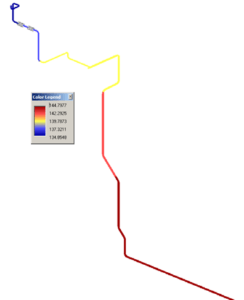
Slug Impact on a Closing HIPPS Valve A 16-inch steel gas riser lands on a platform, and a 12-inch line branches off the riser into the platform. A HIPPS valve on the 12-inch branch protects the downstream platform from pressures exceeding 150 Barg. The 16-inch riser is exposed to slug
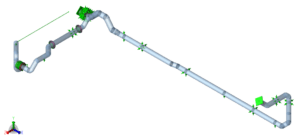
GRE Header Design Conditions and Material Properties An above-ground seawater header in glass-fibre reinforced epoxy (GRE) supplies seawater to a process unit through two tie-ins on a seawater pump discharge manifold. The analysis assessed the static stresses in the header and defined a support arrangement that supports and stabilises the
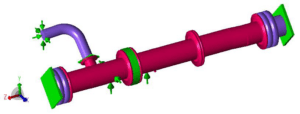
Bellow Overextension in a DN800 GRE Seawater Spool A DN800 spool in glass-fibre reinforced epoxy (GRE) was to be installed to transport seawater. The GRE material has unequal axial and hoop stiffness, with an axial elastic modulus of 10,500 MPa and a hoop elastic modulus of 20,500 MPa. Its “effective”

DYNAFLOW RESEARCH GROUP (“DRG”) Enters into Reseller Agreement with Quality Professional Software (“QPS”) RIJSWIJK, The Netherlands – January 24, 2024 (Dynaflow Research Group BV) –

Dynaflow Research Group and Seawind Ocean Technology announce collaboration focusing on technical readiness of floating offshore wind applications in the Mediterranean Sea. This landmark partnership