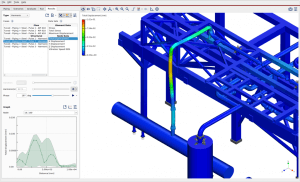
Software
Complete Pulsation Analysis Using BOSpulse – Q&A Session
Is it required to have node increments in piping according to flow direction? The node numbering is not related to the flow direction. The flow

Is it required to have node increments in piping according to flow direction? The node numbering is not related to the flow direction. The flow

Our 2025 classroom training course schedule for CAESAR II Statics, CAESAR II Dynamic and PV-Elite is online! We also offer a wide range of online training courses in fiberglass engineering, fluid flow, piping and pressure vessel design.

The combustion air system of an incinerator is a crucial component for its operation, consisting of a fan, two skids, interconnecting piping, and the incinerator

Introduction In a large industrial plant located in the southern Netherlands, a complex pipeline network traverses multiple sections separated by two major highways. This network,
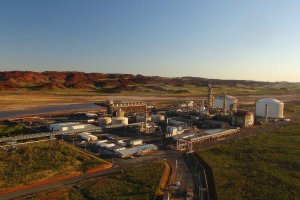
A new off-loading system is under consideration for an ammonia storage plant, designed to transfer ammonia (NH3) from a jetty to three storage tanks. This

The exploration of various methods to enhance the Finite Element Analysis (FEA) of a 6-bed polybed vessel focuses on addressing potential fatigue issues. A Finite
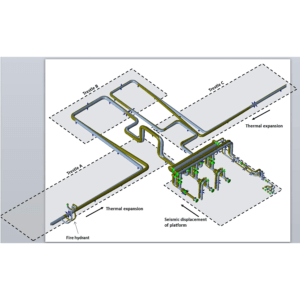
During the design phase of a sea jetty for an oil terminal, Dynaflow Research Group (DRG) conducted a comprehensive stress analysis for the glass reinforced

The vessel under consideration features three horizontal trays positioned at different elevations. These perforated trays are supported by and welded to a support ring, which

A finite element analysis (FEA) was requested for a fiberglass coupler used in centrifugal cast fiberglass pipes. The aim was to evaluate the structural integrity
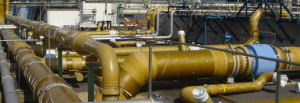
In the framework of a testing program for glass-reinforced epoxy (GRE) pipes, the long-term material strength properties at a high temperature of 150°C are determined
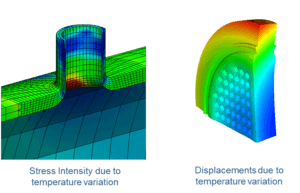
A shell and tube heat exchanger is utilized to condense propylene gas. The temperature of the propylene gas entering the shell side cycles through a

The client requested a static stress analysis for two cooling water headers, which were to be replaced with headers made from Glass Reinforced Epoxy (GRE).

Two identical spherical tanks, designed and commissioned in the 1960s for the storage of pressurized liquid butane, require re-evaluation for a new purpose. Each tank

A dryer vessel is designed for the purpose of removing water from ‘wet’ propylene liquid, where ‘wet’ denotes the presence of a small quantity of
A 5-inch glass-reinforced epoxy (GRE) transportation line has been installed underground, featuring several above-ground steel pipe connections. Designed to withstand a pressure of 150 bar

A planned modification to a cokes gas piping involves the installation of a new pipeline to a gas user and the decommissioning of an existing

A stress analysis was conducted on a tubular heat condenser utilizing finite element analysis (FEA). This condenser configuration includes a rotational asymmetric tube bundle secured

Introduction Following the replacement of an older tail gas heater, issues with leakage from the top tubesheet flange connection have emerged during production. Despite attempts
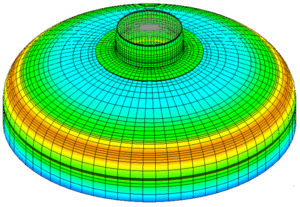
This case study details the determination of wall thickness for a Glass Reinforced Epoxy (GRE) tank. Analysis The process of defining the wall thickness was

A large-diameter seawater dump caisson, constructed from Glass Reinforced Epoxy (GRE), required a comprehensive strength assessment. This caisson featured five nozzles, with one positioned in

Dynaflow Research Group (DRG) conducted a static analysis of a rectifier or afterwash column, which consisted of a carbon steel shell with a 15 mm

Hydrogen is considered to be a key element in the energy transition. This molecule is the most notable option for the decarbonisation of hard-to-abate sectors
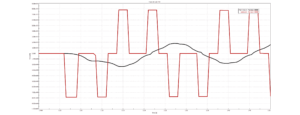
As part of our responsibilities at DRG, we conduct both standard pressure drop calculations and surge/slug analyses for firewater systems. Our involvement spans various stages,
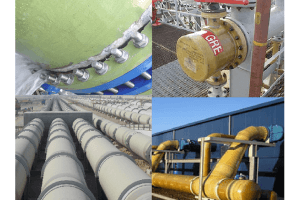
Geothermal energy is a promising renewable energy source, but it comes with its own set of challenges. Two significant issues in geothermal well operations are
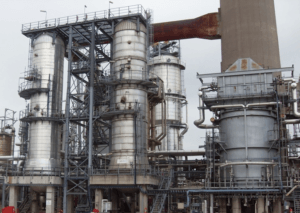
Flow-induced vibrations in piping systems are a critical aspect of mechanical engineering, impacting the reliability and integrity of various industrial setups. The Japan Society of

Introduction In the field of engineering design, the precision of pipe flexibility analysis models is critically important for accurately assessing nozzle loads in steel piping

In 2013, a major incident occurred in a Louisiana chemical plant. In a nonroutine operation, plant operators attempted to start a heat exchanger which had

To understand pressure surges in large piping systems, a good place to start is at home. When you finish washing your hands, turning off the

Brief introduction to piping vibrations Vibrations are an oscillatory motion about an equilibrium. The oscillatory movement causes alternating stresses in the system, which, if excessive

The pulsation challenge of a variable speed reciprocating compressorA pulsation analysis according to the API 618 is a good method of preventing excessive vibrations in

ON-DEMAND 🕖 30 MIN 🌏︎ ENGLISH Understanding and Mitigating AIV and FIV in Modern Plant Design David Tickner Senior Engineer Get instant access
ON-DEMAND 🕖 30 MIN 🌏︎ ENGLISH How To Predict Stresses From Slug Flows Daniëlle de Jong Senior Engineer Get instant access Free recording
ON-DEMAND 🕖 60 MIN 🌏︎ ENGLISH Building models using the import PCF file feature & model verification In BOSfluids Thijs Krijger Project Engineer

ON-DEMAND 🕖 60 MIN 🌏︎ ENGLISH Solving Vibrations In A Two-Phase Process Line Frank Bos Partner Get instant access Free. Recording + slide

ON-DEMAND 🕖 50 MIN 🌏︎ ENGLISH Surge and dynamic stress analysis for an offshore wind farm using BOSfluids Mark Groen Software Lead Engineer

ON-DEMAND 🕖 25 MIN 🌏︎ ESPAÑOL Integración de BOSfluids con Caesar II y otros programas de tensión de tuberías Uri Peker Engineer Get instant
ON-DEMAND 🕖 35 MIN 🌏︎ ENGLISH BOSfluids integration with CAESAR II and other pipe stress programs Ryan Metcalf Manager USA Get instant access
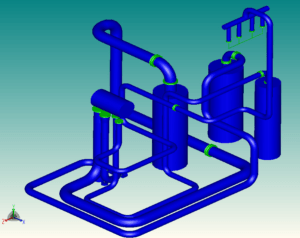
Why Pulsation Risks Warranted Attention Before Operation The compression station was designed to increase and maintain operating pressure on a natural gas piping network, overcoming friction losses. It has four (3+1) two-stage centrifugal compressors with 19-blade impellers, running at a rated speed of 5750 RPM (95.8 Hz) within a range
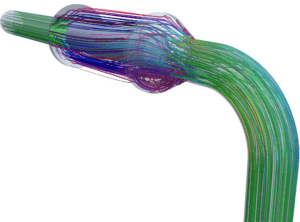
A Commissioning Failure That Sent Debris Downstream During commissioning of a natural gas compressor station, pieces of fibreglass fabric, mineral wool and steel wire were found throughout the downstream system. A small amount of mineral wool was also found in the surge valve. Inspection showed that the mineral wool found
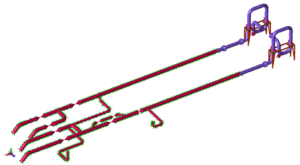
Compressor Piping Under Combined Marine and Process Loading The compressor module was located roughly halfway along the hull. Its connected piping had to accommodate thermal and pressure loads, wind loads, accelerations from wave-driven barge rocking and relative displacements from hull deformation. These loads could produce pipe deflection and bending and
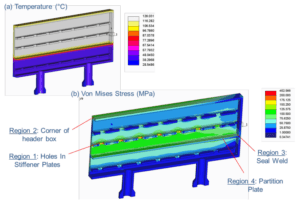
Cyclic Thermal Duty in a Gas Treatment Air Cooler An air-cooled heat exchanger for a gas treatment plant is subjected to a varying inlet temperature. In the analysed winter case, which has the largest temperature variation, the fluid cycles between 7.5°C and 288°C during each 100-minute cycle. The first part
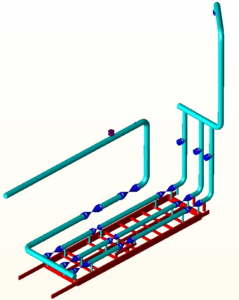
Consolidating Gas Flow onto a Single Metered Line A platform gas metering station has three parallel metering lines, two active and one spare. The modification replaces the orifice-type flow meter in the most eastern line with an ultrasonic (US) flow meter and directs the complete gas flow through that line.
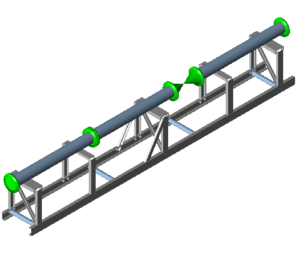
Nitrogen Skid Stress Verification Requirement A manufacturer produces a nitrogen metering skid for a project. As a result of a client performance requirement, the existing design had to be verified by stress analysis. The skid is a straight pipe configuration with valves and flow meters, supported approximately 1000 mm above
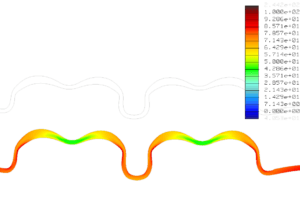
An axisymmetric finite element analysis checked the flued flange expansion joint of a fixed-fixed tubesheet reboiler for low cycle fatigue, high cycle fatigue and primary stress to ASME Section VIII Division 2, at mean (26 mm) and minimum (22 mm) wall thickness. The largest low cycle fatigue stress range was
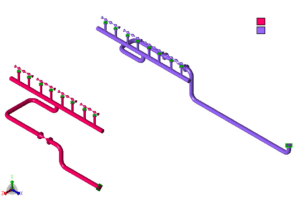
The station model of the Winksele Compressor Station, to be built in Belgium, was divided into two models with some mutual overlap, a compressor model and a filter model, each covered by a separate stress report. A third report covers the gas air coolers as model C, an add-on to
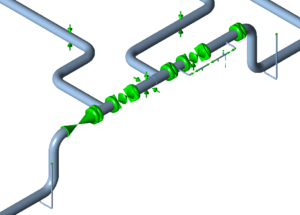
An additional separator was installed in Phase 2 of a cluster project and was to be connected to the existing lines through a modified above-ground (A/G) manifold. The manifold also connects to an existing buried (underground, or U/G) line. The analysis applied pressures of 100 / 225 Barg and temperature
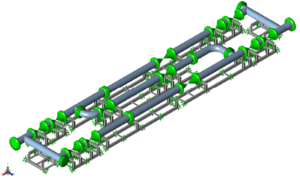
A combined CAESAR II model of a gas metering skid and its structural steel frames was assessed against ASME B31.3 (2006). The piping stresses were below the allowables, the steel stresses were within the allowable limits for the sustained and expansion load cases, and several bolt shear loads exceeded the
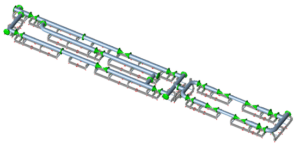
Multi-Mode Metering Skid with Undefined Connecting Piping The unit assessed was a 24-inch, 300# ethane metering skid. Gas can be routed through a normal operating line (line 1), a testing and maintenance line (line 2), two flow control lines (lines 3 and 4) and a bypass. No more than one
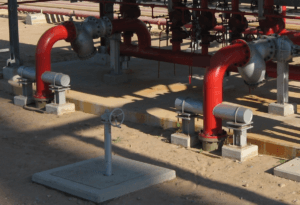
CAESAR II stress analysis of 13 critical sections of a buried GRP fire water system, to ISO 14692, expected no problems for the underground piping under pressure and temperature loads. High stresses occurred in vertical above-ground GRP pipes where the pipe is vertically restrained; in section D, guide and rest
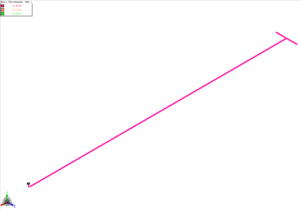
Seventeen underground GRE firewater subsystems at a degassing station were analysed in CAESAR II for three load cases, hydrotest, operational and sustained, to ISO 14692. It may be concluded that, upon implementation of the recommendations, the static pipe stresses are acceptable and the flange loads are moderate. Underground GRE Firewater
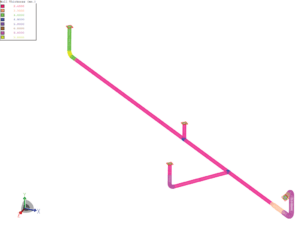
Thirteen buried GRE firewater subsystems were modelled in CAESAR II and assessed to ISO 14692 for hydrotest, operating and sustained load cases. On implementation of the recommendations, static pipe stresses are acceptable and flange loads are moderate. The buried glass-reinforced epoxy (GRE) piping in the firewater system upgrade at a
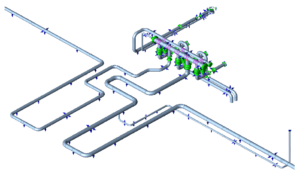
The main firewater line for a new oil terminal jetty is made from glass reinforced epoxy (GRE) pipe. It starts at the onshore transition between underground and above-ground pipe, where it connects to steel lines, and follows a jetty about 1.5 km long. A firefighting platform about one third of
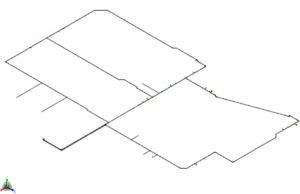
Static stress analysis of two buried GRE firewater subsystems in CAESAR II covered three load cases with a design pressure of 13.4 barg and a maximum design temperature of 40 °C. The stress analysis report, a preliminary issue, records wall thickness increases and polystyrene on five isometrics and concludes that,
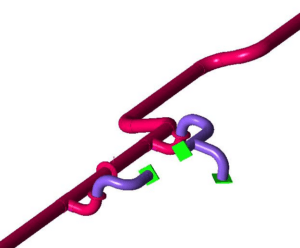
Nine underground GRE firewater systems, 77 stressed isometrics in total, were analysed in CAESAR II against the ISO 14692 allowable stress envelopes, with soil-pipe interaction modelled to the American Lifelines Alliance (2001) soil model. Modifications included a support bracing, polystyrene foam, NBR gasket stiffness limits and additional laminate for a
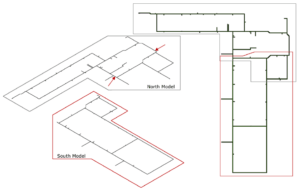
A CAESAR II static stress analysis of a buried GRE firewater network against ISO 14692 found 18 bends and 10 tees overstressed in the original design. In the modified models, all stress points are within the ISO 14692 envelopes for the sustained, operational and hydro load cases, provided the system
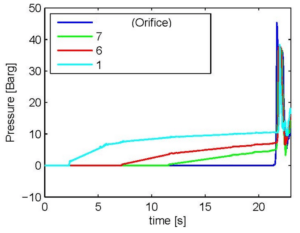
An underground storage station was being expanded with an additional compressor and a third injection well cluster, and the existing firewater package was being extended as part of the project. Two jockey pumps pressurise the system. When a blowout alarm is raised, the deluge valves open and the main firewater
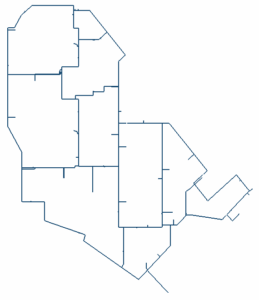
A buried GRE fire water ring was assessed in CAESAR II against the ISO 14692 allowable stress envelope. Static stresses stayed within the envelope for all load cases after additional lamination at nine bends, and the settlement analysis set a 4 MPa axial margin on the operational or occasional envelope.
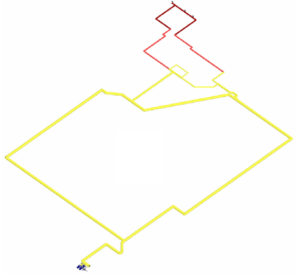
A new unit was added to an existing gas complex, and the firewater ring main was extended to serve it. Three sets of four 3-inch hydrant valves were modelled, twelve hydrants in total. Each hydrant is required to produce a minimum of 1452 l/min at 7.0 barg, and the hydrant

DYNAFLOW RESEARCH GROUP (“DRG”) Enters into Reseller Agreement with Quality Professional Software (“QPS”) RIJSWIJK, The Netherlands – January 24, 2024 (Dynaflow Research Group BV) –

Dynaflow Research Group and Seawind Ocean Technology announce collaboration focusing on technical readiness of floating offshore wind applications in the Mediterranean Sea. This landmark partnership